
Core parameters of Ultrasonic Swiss Roll Cutting Machine
Comparison of Core Parameters between Ultrasonic Swiss Roll Cutting Machine and Traditional Mechanical Cutting Equipment
In the large-scale production of Swiss rolls, the cutting and wrapping processes directly determine product quality, production efficiency, and overall costs. Currently, the mainstream equipment is mainly divided into two categories: ultrasonic Swiss roll wrapping cutting machines (adapted to roll ultrasonic cutting integrated machines) and traditional mechanical cutting equipment. The two have significant differences in core performance and practical application effects. Based on the core production requirements, a comprehensive and detailed comparison is made from five key dimensions: cutting effect, production efficiency, comprehensive cost, applicable scenarios, and additional characteristics, providing reference for equipment selection in baking enterprises.
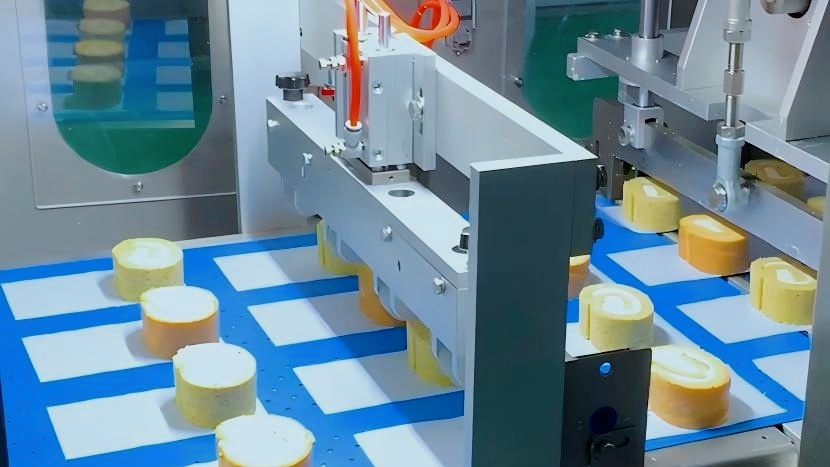
Cutting effect: precise non-destructive vs rough and vulnerable, significant quality difference
The cutting effect is the core guarantee for the appearance and taste of Swiss roll products, and the two devices show obvious layering in cutting accuracy, material protection, and product consistency. The ultrasonic Swiss roll paper cutting machine relies on high-frequency vibration cutting technology to achieve non-destructive and precise cutting of Swiss rolls. Its core advantages are reflected in four aspects: first, the incision is smooth and flat, without any debris residue, and there will be no collapse problem, which can perfectly preserve the fluffy tissue and clear layers of the cake embryo, making the finished product more outstanding in appearance; Secondly, for fillings with strong stickiness such as cream, jam, and mousse, high-frequency vibration can form a slightly heat sealed section, effectively avoiding the filling from sticking or overflowing, ensuring product cleanliness and reducing material contamination; Thirdly, the cutting accuracy is extremely high. Through servo synchronous control, the cutting error can be controlled within ± 0.5mm. No matter how many products are produced in bulk, the specifications can be maintained at a high degree of uniformity; The fourth is that there is no mechanical compression during the cutting process, which will not cause the roll to crack, deform or expose the filling. The finished product rate can be stable at over 99%, greatly reducing the loss of unqualified products.
On the other hand, traditional mechanical cutting equipment is limited by the cutting principle, and there are many shortcomings in the cutting effect: the squeezing cutting of mechanical blades is prone to damage the cake tissue, resulting in debris and collapse of the incision, blurring the layers, and seriously affecting the appearance of the product; When facing sticky fillings, the blade is prone to sticking to the filling, which not only causes the filling to overflow, but also pollutes the equipment and subsequent products, increasing the cleaning burden; The cutting accuracy is poor, with errors generally above ± 1.5mm. During mass production, the specifications of the finished products are uneven, and consistency is difficult to guarantee; In addition, mechanical extrusion can easily cause cracking and deformation of the roll, and the yield can only be maintained at around 85% -90%. The loss of unqualified products is much higher than that of ultrasonic equipment.
Production efficiency: Integrated continuous operation vs intermittent tedious operation, doubling the efficiency gap
For large-scale baking production, production efficiency directly determines the upper limit of production capacity, and the differences in operation mode, speed, and manpower requirements between the two equipment directly affect the overall efficiency of the production line. The ultrasonic Swiss roll wrapping paper cutting machine adopts the integrated design of “cutting+wrapping” to realize continuous dynamic operation. It can complete the seamless connection between cutting and wrapping paper without stopping the machine, greatly improving the operation efficiency. From the specific parameters, a single device can produce 80-1500 pieces per hour, supporting 1-10 pieces for parallel cutting, and can be flexibly adjusted according to production capacity requirements; At the same time, the anti sticking knife design reduces the frequency of shutdown cleaning, and the comprehensive utilization rate of the equipment can reach over 95%, effectively avoiding the waste of production capacity caused by ineffective shutdown. In terms of manpower demand, a single ultrasonic equipment can directly replace 5-10 people, covering two core processes of cutting and wrapping, completely getting rid of the dependence on manpower, and adapting to the large-scale production demand of high-speed continuous production line.
Traditional mechanical cutting equipment adopts an intermittent operation mode, where the cutting and paper wrapping processes are independent of each other, and the connection is cumbersome. During the cutting process, intermittent shutdowns are required for adjustment, which seriously restricts production speed. The hourly output of a single device is only 40-800 pieces, and most of them are single row cutting, making it difficult to improve speed; Due to the tendency of the blades to stick to the material, frequent shutdowns and cleaning are required, resulting in a comprehensive utilization rate of less than 75% and severe production capacity loss. In terms of labor cost, traditional equipment needs to be equipped with 3-6 special personnel who are respectively responsible for cutting, wrapping and equipment cleaning. The labor input is large, and the instability of manual operation will further affect the production efficiency, which is difficult to adapt to the needs of large-scale mass production.
Comprehensive cost: high initial investment vs long-term high loss, large-scale production has more advantages
Equipment selection should take into account both initial investment and long-term operating costs. The two types of equipment have significant differences in cost structure and are suitable for the needs of enterprises of different scales. The core feature of the ultrasonic Swiss roll paper cutting machine is “high initial investment and low long-term loss”. Its initial equipment investment is 30% -60% higher than traditional mechanical equipment, and the entry threshold is relatively high, but the long-term operating cost advantage is significant. In terms of material loss, the non-destructive cutting method of ultrasonic equipment can reduce material loss by more than 40% compared to traditional equipment, which can save a lot of raw material costs in the long run; In terms of maintenance costs, the ultrasonic blade has a lifespan of over 5 million cuts, with low maintenance frequency and no need for frequent replacement of parts, further reducing operating costs; In addition, the significant savings in labor costs enable large-scale production (with a daily output of ≥ 10000 units) to recover the price difference of initial equipment investment in only about six months, resulting in lower long-term comprehensive costs.
The advantage of traditional mechanical cutting equipment lies in its low initial investment, low entry threshold, and suitability for small businesses with limited budgets, but its long-term operating costs are relatively high. Due to issues such as squeezing and sticking during the cutting process, material loss is severe and the cost of raw material waste remains high; Mechanical blades are prone to wear and deformation, requiring frequent replacement and high maintenance frequency. The maintenance cost is much higher than that of ultrasonic equipment; At the same time, a large amount of manpower investment leads to a continuous increase in long-term operating costs, especially in large-scale production, where manpower costs far exceed the price difference of initial equipment investment, resulting in higher overall costs and making it difficult to achieve the goal of cost reduction and efficiency improvement.
Applicable scenarios: High end scale vs low-end small batch, accurately matching production needs
Based on the performance characteristics and cost structure of the two devices, there is a clear distinction in their applicable scenarios, which can accurately match the production needs of enterprises of different scales and positioning. The ultrasonic Swiss roll paper cutting machine is more suitable for mid to high end and large-scale production scenarios, including large-scale baking central factories, prefabricated dessert production lines, especially for large-scale production needs with a daily output of ≥ 5000 pieces; Chain baking brands, high-end and internet famous Swiss roll production enterprises, such enterprises have high requirements for product appearance and standardized quality, and ultrasonic equipment can perfectly meet their quality positioning; In the production scenarios of frozen cakes and semi thawed Swiss rolls, ultrasonic equipment can adapt to low-temperature cutting environments to avoid problems such as sticking knives and deformation; In addition, for production lines that require high hygiene standards, comply with HACCP and FDA compliance requirements, and pursue full process automation, the automated operation mode of ultrasonic equipment can effectively eliminate secondary pollution caused by manual contact, which meets the needs of hygiene control.
Traditional mechanical cutting equipment is more suitable for low-end, small batch production scenarios, mainly including small pastry processing factories and individual workshops, which have lower output (daily production ≤ 3000) and do not require high quality of finished products; Low end Swiss roll and ordinary pastry production enterprises do not need to pursue high aesthetics and standardization, and can accept a certain amount of finished product loss; Production scenarios that have no demand for large-scale production, limited budget, and pursue low-cost entry; In addition, for the cutting of non sticky fillings (such as anhydrous bean paste) and hard cake embryos, and without the need for complex paper wrapping processes, traditional mechanical equipment can basically meet the production requirements without the need to invest high costs in purchasing ultrasonic equipment.
Additional advantages and disadvantages: automation vs simplification, adapted to different development needs
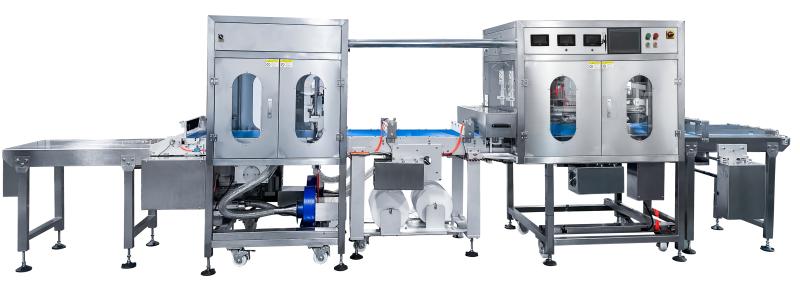
In addition to the core parameters, the additional features of the two devices further determine their adaptation scenarios. The additional advantages of the ultrasonic Swiss roll wrapping paper cutting machine are very prominent. Its high degree of automation can directly connect with the cake stacking and packaging equipment, realize the closed-loop operation of the whole process of “rolling cutting wrapping cake packaging”, and greatly improve the automation level of the production line; The entire equipment is made of food grade 304/316 stainless steel material, with a simple structure that is easy to disassemble and clean, meeting the hygiene requirements of food production; Equipped with a PLC intelligent control system, it can preset parameters, store formulas, support fault alarms, remote monitoring, operate conveniently, and quickly switch product specifications to meet the production needs of multiple varieties. Its only weakness lies in the high initial investment, which puts significant budget pressure on small businesses.
The additional features of traditional mechanical cutting equipment are centered around simplicity, with a simple device structure and low operating threshold, which can be mastered without the need for professional technicians; The equipment has a relatively small volume and occupies less space, making it suitable for small production entities with limited space. But its shortcomings are also quite obvious, with a low degree of automation, unable to achieve closed-loop operations throughout the entire process, requiring manual connection of various processes, which is prone to operational errors; The difficulty of hygiene control is high, with a lot of manual contact, making it difficult to fully meet the hygiene standards for high-end food production; No intelligent control system, complicated parameter adjustment, inability to quickly switch product specifications, poor adaptability; And the equipment wears out quickly, and its performance stability decreases after long-term use, affecting the consistency of finished product quality.
Summary
The core difference between the ultrasonic Swiss roll paper cutting machine and traditional mechanical cutting equipment is essentially the difference between “high-end automation” and “low-end simplification”. If a company pursues high quality, high output, low loss, and has a large-scale production plan and sufficient budget, it should prioritize choosing the ultrasonic Swiss roll paper cutting machine. Its long-term efficiency advantages, cost advantages, and quality advantages can enhance the company’s core competitiveness; If the enterprise is a small entity with low output, limited budget, and low requirements for finished product quality, traditional mechanical cutting equipment can be used as an entry-level choice to meet basic production needs. Overall, with the trend of large-scale, standardized, and high-end development in the baking industry, ultrasonic Swiss roll paper cutting machines (adapted to roll ultrasonic slitting integrated machines) have become the core choice for large and medium-sized baking enterprises to reduce costs, increase efficiency, and improve product quality.
About Cheersonic
Cheersonic manufactures the leading portioning equipment for bakeries producing fresh and frozen desserts. Since 1998 bakers have used Cheersonic machines to cut, slice and portion cheesecake, pie, layer cake, loaves, butter, cheese, pizza, sandwichs, and more. Cheersonic offers ultrasonic cutting solutions that support start-up bakeries and high production commercial facilities alike. Small standalone machines can be used in manual baking facilities and large inline robotic solutions aid in high speed production.
Cheersonic offers many ultrasonic slicing models, both inline and offline applications, with production speeds of 80 to 1,500 cakes or pies per hour.
Cheersonic’ latest offline introductions include ultrasonic cutting with or without divider inserts between each slice. This improves the quality of the cut and makes for a much better product presentation for the customer. In addition, robotic arm improves the speed, efficiency, and accuracy of the cutting process, producing professional looking products every time.
