
Ultrasonic Cutting for Toast Slicing & Packaging
Ultrasonic Cutting for Toast Slicing & Packaging – Cheersonic
In the industrial production of baked goods, the toast slicing process has long faced a challenging technical problem: traditional metal blades, during high-speed cutting, easily compress and deform the soft bread structure, resulting in rough cuts, excessive crumbs, and not only affecting product appearance but also wasting raw materials. With continuous innovation in food processing technology, the introduction of ultrasonic cutting technology has brought a breakthrough to the toast slicing process, forming a highly efficient synergy with automated packaging systems and significantly improving the overall efficiency of the production line.
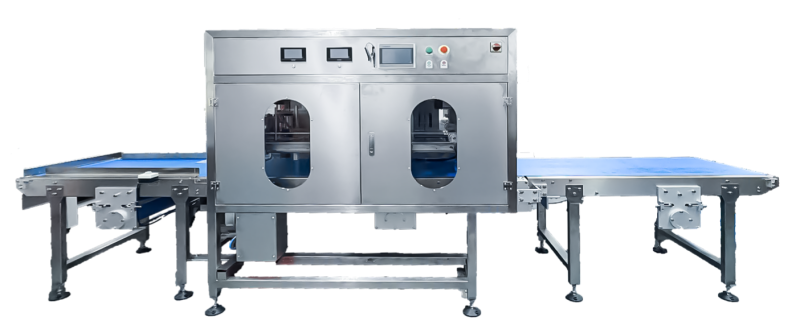
The working principle of ultrasonic cutting technology is based on high-frequency vibration. The cutting head generates micro-vibrations at a frequency of tens of thousands of times per second, creating a tiny air gap between the blade and the toast contact surface, thereby significantly reducing cutting resistance. In this working mode, the blade no longer relies on strong compression to cut the bread structure but rather completes the cut through a “separation” process, preserving the dense porous structure of the toast intact, resulting in a smooth cut surface with almost no crumbs. Compared to traditional cutting methods, equipment using ultrasonic technology can reduce crumb generation by more than 80%, which has significant economic value for food companies pursuing high yield and high quality. In actual production line configurations, ultrasonic cutting systems typically work in conjunction with automated conveyor belts, positioning devices, and slitting molds. After the toast cools and is demolded, its position is automatically calibrated by an intelligent vision system to ensure uniform thickness with each cut. The equipment can flexibly set the slice thickness and quantity, allowing for quick adjustments to both standard and extra-thick slices without changing the blade assembly, greatly improving production flexibility. Multiple ultrasonic blades can operate in parallel, completing the entire slice of toast in one go, with single-slice processing time controlled within seconds, meeting the needs of high-volume continuous production.
After addressing the quality and efficiency issues in the cutting process, seamless integration of the packaging process becomes crucial to the overall solution. In traditional processes, cut toast slices are prone to sticking or shifting due to vibrations during stacking or conveying, affecting the neatness of subsequent packaging. To address this pain point, advanced integrated production lines incorporate a buffer and sorting section between the cutting and packaging stations, using a gentle clamping and conveying device to keep the slices upright as they are fed into the packaging track. Ultrasonic-cut toast slices are dry and non-stick to the blade, reducing the likelihood of adhesion to the conveyor belt and other mechanical parts, creating favorable conditions for automated packaging.
Packaging typically employs pillow-type or box-type packaging. The prepared toast slices are fed into pre-made packaging film via a servo-driven feeding mechanism, completing a series of actions including shaping, sealing, and cutting. For products requiring modified atmosphere packaging or nitrogen-filled packaging, the system can simultaneously perform gas replacement, effectively extending shelf life. Throughout the process, the cutting and packaging cycle time is uniformly coordinated by a central control system, achieving dynamic matching between cutting and packaging speeds and avoiding material accumulation or production line delays due to efficiency differences between upstream and downstream workstations.
In summary, the toast slicing and packaging solution based on ultrasonic cutting technology demonstrates significant advantages in four dimensions: product quality, production efficiency, raw material utilization, and equipment flexibility. It solves the industry-wide common problem of deformation when cutting soft baked goods, while also clearing obstacles for subsequent automated packaging. For baking manufacturers, introducing this technology means lower waste rates, more refined product appearance, and more efficient production organization—a viable path to cost reduction, efficiency improvement, and quality upgrades in a fiercely competitive market. With the continuous advancement of ultrasonic drive technology and intelligent control systems, the application scenarios of this solution will further expand to the processing of more soft or sticky foods.
About Cheersonic
Cheersonic manufactures the leading portioning equipment for bakeries producing fresh and frozen desserts. Since 1998 bakers have used Cheersonic machines to cut, slice and portion cheesecake, pie, layer cake, loaves, butter, cheese, pizza, sandwichs, and more. Cheersonic offers ultrasonic cutting solutions that support start-up bakeries and high production commercial facilities alike. Small standalone machines can be used in manual baking facilities and large inline robotic solutions aid in high speed production.
Cheersonic offers many ultrasonic slicing models, both inline and offline applications, with production speeds of 80 to 1,500 cakes or pies per hour.
Cheersonic’ latest offline introductions include ultrasonic cutting with or without divider inserts between each slice. This improves the quality of the cut and makes for a much better product presentation for the customer. In addition, robotic arm improves the speed, efficiency, and accuracy of the cutting process, producing professional looking products every time.