
Ultrasonic Cutting Production Lines to Cut Raw Dough
Pastry and Bakery Shops Use Ultrasonic Cutting Production Lines to Cut Raw Dough
In the pastry and bread production process, raw dough cutting is a crucial step determining product quality and production efficiency. Traditional cutting methods often face problems such as dough sticking, irregular edges, high loss rates, and low efficiency, making it difficult to meet the large-scale, standardized production needs of the modern baking industry. The introduction of ultrasonic cutting production lines provides pastry and bakery shops with an efficient solution to these pain points, redefining the precision and efficiency of raw dough cutting with its unique technological advantages.
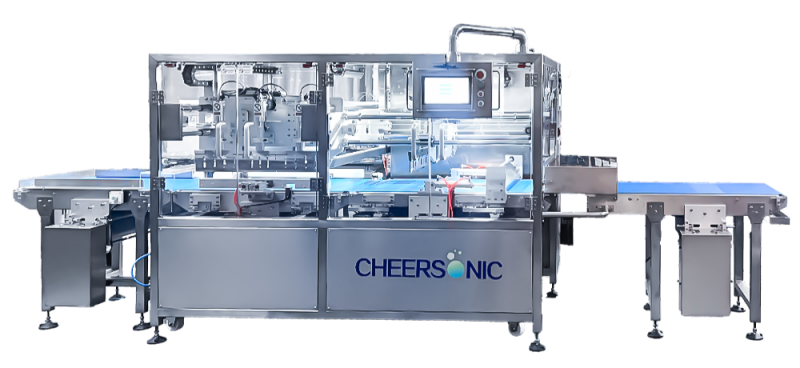
The core working principle of the ultrasonic cutting production line is to achieve precise material separation using high-frequency mechanical vibration. The system mainly consists of an ultrasonic generator, transducer, amplifier, and cutting head. The generator converts standard electrical energy into a high-frequency electrical signal of 20-40 kHz. The transducer then converts the electrical signal into mechanical vibration of the same frequency. After the amplifier amplifies the amplitude, it is transmitted to the cutting head, causing the cutting head to vibrate longitudinally at a frequency of 20,000 to 40,000 times per second. This high-frequency vibration frees the cutting process from the reliance on sharp blades and immense pressure inherent in traditional mechanical cutting. When the blade contacts the raw dough, the vibrational energy disrupts the bonds between dough molecules, achieving a near-resistance-free cutting effect.
Compared to traditional cutting methods, ultrasonic cutting production lines exhibit numerous irreplaceable advantages in raw dough cutting. Firstly, the cutting quality is exceptionally precise. High-frequency vibration minimizes the contact time between the blade and the dough, significantly reducing frictional resistance and avoiding common problems in traditional cutting, such as tearing, edge chipping, and deformation. The cut dough has smooth, even edges, with dimensional errors controlled to the millimeter level, ensuring uniformity in subsequent baking. Even multi-layered dough or composite dough containing fillings can be cut neatly without layer separation or filling extrusion.
Secondly, it significantly reduces material waste and production costs. During traditional cutting, dough easily sticks to the blade, requiring frequent cleaning, impacting efficiency, and resulting in substantial material waste. The high-frequency vibration of the ultrasonic cutter head has a self-cleaning effect, effectively preventing dough sticking and reducing downtime for cleaning. This reduces material loss from over 5% in traditional methods to below 0.5%. Furthermore, the cutter head experiences minimal wear due to reduced friction, significantly extending its lifespan and lowering equipment maintenance and parts replacement costs.
Thirdly, it improves production efficiency and automation. Ultrasonic cutting production lines can be easily integrated into automated pastry and bread production processes, enabling continuous conveying, precise positioning, and high-speed cutting of raw dough, far exceeding the cutting speed of manual and traditional mechanical cutting. For different specifications of pastries and breads, the cutting size and shape can be quickly adjusted by setting relevant parameters in the control system. Whether it’s straight cutting or complex wavy or serrated cutting, it can be achieved precisely, greatly improving production flexibility and response speed, especially suitable for mass production during peak order periods.
Fourthly, it ensures production hygiene and food safety. The food industry has stringent hygiene requirements. The self-cleaning characteristics of ultrasonic cutting equipment reduce material residue and lower the risk of microbial growth. Meanwhile, automated cutting reduces manual intervention, avoids direct contact between operators and raw dough, lowers the risk of cross-contamination, and better meets food production hygiene standards. The equipment’s structural design typically facilitates disassembly and cleaning, further enhancing the hygienic controllability of the production process.
In practical applications, bakeries using ultrasonic cutting production lines need to pay attention to parameter optimization and daily maintenance. The vibration frequency, amplitude, and cutting speed should be adjusted appropriately based on the thickness, hardness, and other characteristics of the raw dough: for thinner, softer dough, a high frequency of 30-40kHz and a medium amplitude can be used, coupled with a higher cutting speed; for thicker dough, the frequency can be appropriately reduced and the amplitude increased to ensure thorough cutting. Regularly check the condition of core components such as the cutter head and transducer to prevent loosening or wear that could affect cutting results. Maintain a dry and clean working environment, away from strong electromagnetic interference, to ensure stable equipment operation.
Ultrasonic cutting production lines, with their advantages of precision, efficiency, energy saving, and hygiene, have brought a revolutionary change to the raw dough cutting process in bakeries. It not only solves many pain points of traditional cutting methods, improving product quality and production efficiency, but also helps baking companies achieve large-scale, standardized production, enhancing their market competitiveness. With the continuous development of the baking industry, ultrasonic cutting technology will play an increasingly important role in pastry and bread production, becoming a crucial choice for modern baking companies’ technological upgrades.
About Cheersonic
Cheersonic manufactures the leading portioning equipment for bakeries producing fresh and frozen desserts. Since 1998 bakers have used Cheersonic machines to cut, slice and portion cheesecake, pie, layer cake, loaves, butter, cheese, pizza, sandwichs, and more. Cheersonic offers ultrasonic cutting solutions that support start-up bakeries and high production commercial facilities alike. Small standalone machines can be used in manual baking facilities and large inline robotic solutions aid in high speed production.
Cheersonic offers many ultrasonic slicing models, both inline and offline applications, with production speeds of 80 to 1,500 cakes or pies per hour.
Cheersonic’ latest offline introductions include ultrasonic cutting with or without divider inserts between each slice. This improves the quality of the cut and makes for a much better product presentation for the customer. In addition, robotic arm improves the speed, efficiency, and accuracy of the cutting process, producing professional looking products every time.