
Sandwich Cutting Solutions
Ultrasonic Sandwich Cutting Solutions: Redefining Precision at Scale
In the high-volume world of ready-to-eat sandwich production, the cutting stage is often the silent bottleneck—a seemingly simple step that can make or break product quality, yield, and line efficiency. Traditional mechanical blades, while familiar, introduce friction, compression, and adhesion that directly conflict with the delicate architecture of modern sandwiches. Ultrasonic vibration technology offers a paradigm shift: by exciting a titanium blade at frequencies beyond human hearing (typically 20–40 kHz), it creates a near-frictionless cutting action. The blade vibrates thousands of times per second, effectively reducing drag to near zero. The result is a clean, shear-like separation that preserves the integrity of soft breads, prevents filling smear, and eliminates the tearing that plagues conventional guillotine or band-saw methods.
The Real-World Challenges of High-Throughput Sandwich Cutting
Manufacturers operating at scale encounter four persistent pain points that directly affect their bottom line:
Ingredient Variability and Product Loss
Sandwiches are not uniform. Soft sourdough, fluffy brioche, or delicate wraps behave differently under pressure. Fillings range from chunky chicken salad to slippery tomato slices, creamy cheese, or moist hummus. When a mechanical blade descends, it compresses the bread before it cuts, often dragging soft crumbs or pushing fillings sideways. This smearing not only ruins the visual appeal but also causes weight loss—crumb particles and displaced filling can represent up to 2–3% of product giveaway, which accumulates into significant annual revenue erosion.
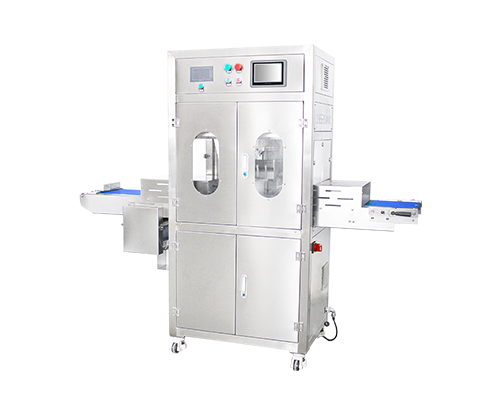
Retail Presentation Standards
Today’s food-to-go market demands visual perfection. Consumers expect to see distinct, layered ingredients through clear packaging—a crisp lettuce layer, a neat cheese slice, and a uniform meat portion. Mechanical slicing frequently pulls fillings apart, compresses wraps into misshapen ovals, or leaves ragged edges that look unappetising. In a category where purchase decisions are made in seconds at the shelf, inconsistent appearance directly impacts brand trust and repeat sales.
Throughput and Line Synchronisation
Upstream assembly lines run at steady speeds, and downstream packing stations require a constant flow of portioned products. Traditional blade systems are prone to accumulation of sticky residues—cheese, mayonnaise, or avocado—which forces operators to pause production for cleaning every 20–30 minutes. These unscheduled stops disrupt line balance, reduce overall equipment effectiveness (OEE), and create a ripple effect that lowers total output. Even with automated cleaning, the downtime often exceeds 15% of planned production time.
Hygiene, Allergen Control, and Operator Safety
Sandwiches containing eggs, chicken, or seafood are high-risk vectors for *Listeria monocytogenes* and other pathogens. Additionally, cross-contact with allergens (gluten, dairy, nuts) can occur if blades are not thoroughly sanitised between product runs. Mechanical blades have crevices, joints, and mounting hardware where food particles become trapped, making deep cleaning labour-intensive and often ineffective. Moreover, sharp steel blades pose laceration hazards during manual handling and blade changes, increasing workplace injury records and compliance burdens.
How Ultrasonic Cutting Transforms Operations
Switching to ultrasonic technology delivers quantifiable improvements across every dimension of production:
Zero-Tear, Zero-Smear Cuts – The high-frequency vibration breaks the adhesive bond between the blade surface and the food matrix. Fillings stay in place, bread retains its springiness, and even multi-layered club sandwiches emerge with razor-sharp edges that maintain structural integrity.
Dramatically Reduced Blade Cleaning – Because the blade’s surface repels sticky ingredients through the ultrasonic “non-stick” effect, residue build-up is minimal. Operators report cleaning intervals extended from 20 minutes to 2–3 hours, and in many cases, a simple quick-wipe between batches suffices, eliminating the need for caustic detergents or high-pressure washing.
Consistent Portion Control – The frictionless cut reduces compression, so portion weights remain stable. This minimises “giveaway” (overfilling to compensate for losses) and ensures that each sandwich meets its declared net weight, improving margin by 1–2% on average.
Rapid Changeover and Integration – Modern ultrasonic systems feature quick-release blade fixtures and tool-less disassembly, allowing changeovers between product sizes or recipes in under five minutes. Their compact design integrates seamlessly with existing conveyor belts, with no need for major line re-engineering.
Enhanced Food Safety – The reduced cleaning frequency and simplified sanitisation protocol lower the risk of biofilm formation. Furthermore, the ultrasonic blade operates at ambient temperature, avoiding the heat generation that can cook or denature sensitive ingredients—a common issue with high-speed mechanical friction.
In short, ultrasonic cutting is not merely an incremental improvement; it is a strategic enabler for sandwich producers who want to scale without compromising quality, hygiene, or throughput.
About Cheersonic
Cheersonic manufactures the leading portioning equipment for bakeries producing fresh and frozen desserts. Since 1998 bakers have used Cheersonic machines to cut, slice and portion cheesecake, pie, layer cake, loaves, butter, cheese, pizza, sandwichs, and more. Cheersonic offers ultrasonic cutting solutions that support start-up bakeries and high production commercial facilities alike. Small standalone machines can be used in manual baking facilities and large inline robotic solutions aid in high speed production.
Cheersonic offers many ultrasonic slicing models, both inline and offline applications, with production speeds of 80 to 1,500 cakes or pies per hour.
Cheersonic’ latest offline introductions include ultrasonic cutting with or without divider inserts between each slice. This improves the quality of the cut and makes for a much better product presentation for the customer. In addition, robotic arm improves the speed, efficiency, and accuracy of the cutting process, producing professional looking products every time.
