
Integrating Ultrasonic Cheese Cutting Into an Existing Production Line
A cheese cutting machine must work with the complete production process, not only produce an acceptable cut in a demonstration. Manufacturers considering ultrasonic cutting should review infeed, product positioning, cutting patterns, discharge, inspection, packaging, cleaning, and control-system requirements before selecting equipment.
Ultrasonic cheese cutting uses a high-frequency vibrating blade and may help reduce cutting resistance for suitable products. The practical value of the technology depends on the cheese and how the machine is integrated into the line. A structured review helps identify interface requirements early and avoids treating cutting performance as the only decision criterion.
Start With the Product and Process Map
Document the cheese formats to be processed, including dimensions, temperature range, packaging state, target portions, and expected product variation. Map the flow from arrival at the cutting station to downstream handling. Identify where the product is aligned, restrained, measured, cut, discharged, inspected, and packaged.
This process map helps determine whether the new system can fit the existing layout and which interfaces need engineering review. It also highlights whether the same machine must handle multiple cheese varieties or portion patterns.
Infeed and Product Positioning
Consistent cutting begins with repeatable product presentation. Blocks that arrive at different angles or move during cutting may produce inconsistent geometry even when the blade is suitable. Review conveyor surfaces, guides, spacing, fixtures, and transfer points.
Soft cheese may require gentle support to reduce deformation. Harder or brittle cheese may need stable positioning to limit unwanted movement or fracture. The correct arrangement depends on the product and target cut, so test representative samples in a realistic handling sequence.
Cutting Parameters and Recipe Changes
Different cheese varieties may require different cutting settings, blade configurations, or handling conditions. If the line changes recipes, define how operators select the correct program and how the machine indicates that a recipe is active. Changeover procedures should be easy to follow and included in operator training.
Ultrasonic cutting should be validated using the intended product temperature and portion geometry. Do not assume that a setting developed for one cheese automatically works for another, even if both products look similar.
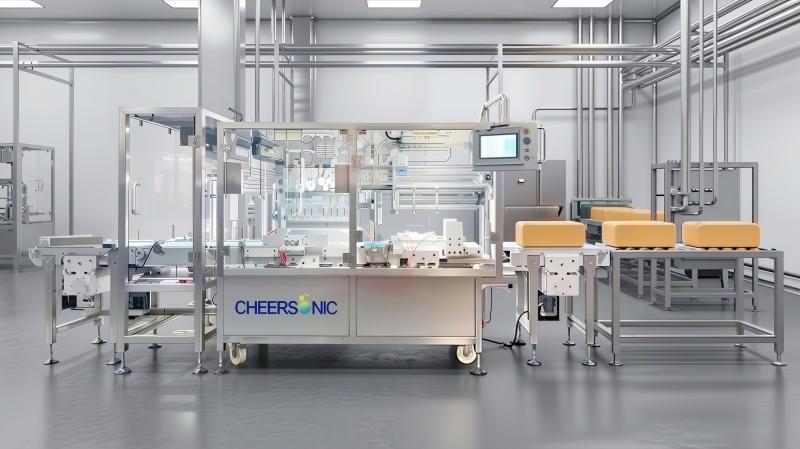
Measurement and Intelligent Control
An intelligent cheese cutting system may include 3D scanning, AI computing, and high-precision weighing depending on its configuration. Scanning can provide information about product geometry, while software may use that information to support cutting-path planning. Weighing can help check portion mass where included in the process.
Before integration, clarify the system’s inputs and outputs, measurement limits, recipe logic, alarms, and handling of out-of-range products. Confirm what data is available to operators and how it can be used for quality records. Measurement and automation should be validated in the actual environment rather than assumed to guarantee portion accuracy.
Controls, Safety, and Communication
Review the interface between the cutting machine and existing conveyors, sensors, emergency stops, guards, and downstream equipment. The plant’s engineering team should confirm the required signals and safe operating sequence. Avoid assuming that all equipment uses the same communication protocol or can be connected without configuration.
Operator access, maintenance clearances, guarding, and emergency procedures are part of the design. Include these requirements early so that the machine can be installed and maintained safely within the available space.
Cleaning and Maintenance
Cheese residue may collect on blades and surrounding food-contact surfaces. Evaluate cleaning access, approved cleaning methods, removable parts, and safe restart procedures. Ultrasonic vibration may reduce residue for some products, but it does not eliminate sanitation requirements.
Also consider blade inspection, preventive maintenance, spare parts, and the availability of service support. A production-line plan should include how equipment is isolated, cleaned, inspected, and returned to service.
Validate the Complete Line
A successful sample cut is only one part of commissioning. Test the complete product flow using representative cheese, realistic speeds, target portion patterns, and downstream packaging. Record cut quality, portion dimensions, weight where relevant, residue, stoppages, and changeover behavior.
- Quality: check edges, deformation, crumbs, and portion geometry.
- Handling: observe product movement and transfer between stations.
- Controls: verify signals, alarms, recipes, and safe stopping behavior.
- Cleaning: confirm access and the approved sanitation workflow.
- Changeovers: test recipe changes and document operator steps.
- Downstream fit: confirm that cut portions are suitable for inspection or packaging.
Plan an Integration Discussion With Cheersonic
Cheersonic works with food manufacturers exploring ultrasonic cutting solutions. The Intelligent Cheese Cutting System page provides a starting point for discussing cutting patterns, measurement, and process needs.
Contact Cheersonic with your cheese type, product dimensions, target portions, current line layout, and control requirements. Qualified manufacturers can arrange a sample cutting test and discuss the information needed to evaluate integration into the intended production process.
Frequently Asked Questions
Can ultrasonic cutting be added to any production line?
Not automatically. Space, handling, controls, safety, cleaning, and downstream interfaces must be reviewed.
Will one recipe work for every cheese?
Not necessarily. Product composition, temperature, and geometry may require separate validated settings.
Does 3D scanning remove the need for inspection?
No. Scanning can support measurement, but results and finished portions still need suitable quality checks.
What information should be prepared before integration?
Prepare product specifications, target portions, line layout, handling sequence, cleaning requirements, and control-system information.
Email: market2@cheersonic.com
WhatsApp: +8615869049660
