
Ultrasonic Cutting of Pet Chicken Breast Meat Snacks
Ultrasonic cutting machines have gradually become an important equipment for efficient and high-quality production in the processing of pet chicken breast snacks, thanks to their unique cutting principles and performance advantages. The following provides a detailed analysis from the aspects of principle adaptability, core advantages, operational points, and application value:
The principle of ultrasonic cutting and the adaptability of pet chicken breast snacks
The core principle of ultrasonic cutting is to convert mechanical energy into local high-frequency impact of the material through high-frequency vibration (usually above 20kHz) of the blade, so that the material can achieve “brittle fracture” under vibration stress, rather than the “extrusion fracture” of traditional cutting. This characteristic is highly compatible with the processing requirements of pet chicken breast snacks:
The raw material of pet chicken breast snacks (chicken breast) usually has the characteristics of soft texture, high moisture content, and fragility (especially after steaming and baking, the tissue of chicken breast is looser). Traditional cutting methods such as knife cutting and mold stamping are prone to deformation of meat tissue, rough edges, excessive debris, and even damage to nutritional structure due to pressure compression; The “vibration separation” mode of ultrasonic cutting can minimize mechanical damage to meat tissue and is more suitable for the physical characteristics of chicken breast.
The core advantages of ultrasonic cutting in pet chicken breast snacks
1. Smooth cutting surface, reducing debris and waste
Traditional knife cutting or stamping can cause the edges of chicken breast meat to “tear” due to compression, resulting in a large amount of debris (especially soft cooked chicken breast meat); The high-frequency vibration of ultrasonic blades can instantly separate tissues, with a flat and smooth cutting surface and no burrs or broken edges. This not only improves the regularity of product appearance (such as the neatness of strip and sheet snacks), but also reduces raw material waste and lowers subsequent cleaning costs.

2. Low temperature cutting to preserve nutrition and taste
The core nutrients of chicken breast meat, such as protein and moisture, are sensitive to high temperatures. The friction heat generated by traditional cutting or the high temperature generated by laser cutting can easily cause local protein denaturation and moisture loss, affecting the taste (such as dryness and hardness) and nutrient retention of snacks. Ultrasonic cutting is mainly based on “mechanical energy vibration” and generates very little heat (usually with a temperature increase of ≤ 5 ℃ in the cutting area), which can avoid damage to chicken breast meat due to high temperature and maintain its fresh and tender taste and nutritional activity.
3. Reduce compression deformation and adapt to diverse form requirements
Pet chicken breast snacks often need to be processed into shapes such as strips, sheets, and irregular shapes (such as hearts and bones). Traditional cutting pressure can easily cause deformation of soft chicken breast meat (such as bending in strips or uneven thickness in sheets) after thawing or cooking. Ultrasonic cutting has extremely low “extrusion stress” on materials, even for slices or long snacks as thin as 1-2mm, it can maintain a regular shape and meet diverse product design requirements.
4. Efficient adaptation to automated production, enhancing batch processing capabilities
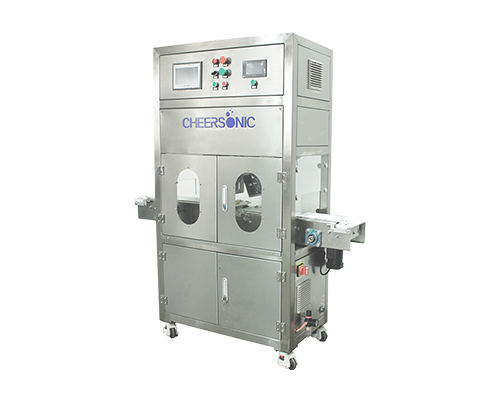
Ultrasonic cutting machines can be integrated into pet snack production lines (such as steaming → cooling → cutting → packaging assembly lines), achieving continuous automated cutting through parameter presets (such as cutting length and speed). A single device can process tens of kilograms of chicken breast meat per hour, greatly improving batch production efficiency, especially suitable for the large-scale needs of small and medium-sized pet food enterprises.
Key points of operation and optimization suggestions
1 Raw material pretreatment: controlling hardness is the core
The hardness of chicken breast directly affects the cutting effect:
- Fully thawed soft chicken breast meat (especially after cooking) is prone to cracking due to excessive vibration. It is recommended to pre treat it in a refrigerated state (0-4 ℃) or slightly frozen (with a slightly hard surface) to reduce deformation during cutting by increasing material hardness.
- If adding auxiliary materials (such as starch, vegetable shreds) to make composite chicken breast snacks, it is necessary to ensure that the raw materials are mixed evenly to avoid cutting discontinuity due to local hardness differences.
2. Equipment parameter debugging: matching frequency, speed, and pressure
- Vibration frequency: Adjust according to the texture of the chicken breast. For soft cooked chicken breast, it is recommended to use 20-25kHz, while for hard (such as those with added grains) or frozen chicken breast, it can be increased to 25-30kHz to avoid excessive frequency causing the material to “shatter”.
- Cutting speed: For thin sheets with a thickness of ≤ 5mm, it is recommended to have a cutting speed of 3-5m/min, and for strips with a thickness of 10-20mm, it is recommended to have a cutting speed of 2-3m/min to ensure that the blade has sufficient time to complete vibration separation.
- Blade pressure: Based on the principle of “light pressure contact”, excessive pressure will increase extrusion deformation, usually set at 0.1-0.3 MPa (specific adjustments need to be made through trial cutting).
3. Blade selection and maintenance: ensuring hygiene and cutting accuracy
- The blade material should be food grade titanium alloy to avoid rust and contamination; The shape is selected according to product requirements (such as straight blade knives for strip/sheet shapes, and irregular blade knives for customized shapes).
- Regularly check the wear of the blade (such as whether the cutting edge has become dull), and promptly polish or replace it after wear, otherwise it may lead to rough cutting surfaces and increased debris.
4. Hygiene control: comply with pet food safety standards
- The equipment should be designed with an “easy to clean structure”, with contact parts such as blades and feeding platforms that can be quickly disassembled. Food grade cleaning agents (such as neutral detergents) should be used for daily cleaning to avoid bacterial growth caused by residual meat residue.
- Regularly disinfect the interior of the equipment (such as vibration generators and circuits).
Summarize
The ultrasonic cutting machine perfectly solves the pain points of “fragility, rough edges, and nutrient loss” in the processing of pet chicken breast snacks through “high-frequency vibration separation” technology. While improving the appearance, taste, and production efficiency of the product, it also meets the strict requirements of pet food for hygiene and safety. For pet food companies pursuing high-quality and large-scale production, ultrasonic cutting is the preferred solution that combines practicality and economy.
About Cheersonic
Cheersonic manufactures the leading portioning equipment for bakeries producing fresh and frozen desserts. Since 1998 bakers have used Cheersonic machines to cut, slice and portion cheesecake, pie, layer cake, loaves, butter, cheese, pizza, sandwichs, and more. Cheersonic offers ultrasonic cutting solutions that support start-up bakeries and high production commercial facilities alike. Small standalone machines can be used in manual baking facilities and large inline robotic solutions aid in high speed production.
Cheersonic offers many ultrasonic slicing models, both inline and offline applications, with production speeds of 80 to 1,500 cakes or pies per hour.
Cheersonic’ latest offline introductions include ultrasonic cutting with or without divider inserts between each slice. This improves the quality of the cut and makes for a much better product presentation for the customer. In addition, robotic arm improves the speed, efficiency, and accuracy of the cutting process, producing professional looking products every time.
Chinese Website: Cheersonic Provides Professional Ultrasonic Cutting Solutions
