
Ultrasonic Cutter for Brownies
Ultrasonic Cutter for Brownies – Fudge Cutting Machine – Cheersonic
In the modern food industry, especially in the post-processing of baked goods, there are increasingly stringent requirements for the precision of cutting techniques and the maintenance of finished product quality. The traditional mechanical cutting method relies on physical pressure and blade action to separate materials. Although it is widely used, it has many inherent limitations. In response to such challenges, advanced cutting technology based on high-frequency mechanical vibration principles has emerged, providing unprecedented processing solutions for dessert products such as brownies that are high-density, high viscosity, and contain rich ingredients (such as kernels and chocolate chips).
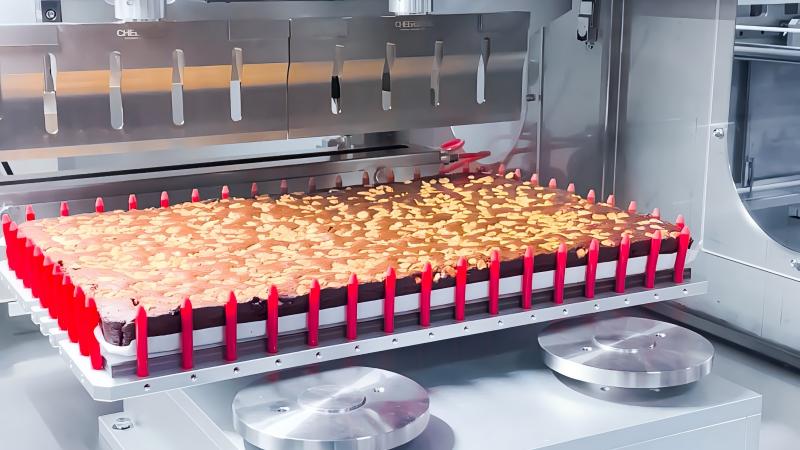
1. Analysis of the limitations of traditional cutting techniques
In the large-scale production of Brownie, conventional cutting tools face several core challenges:
- Adhesion and residue: Brownie has a moist texture and high oil content, making it easy for the blade to adhere to product debris and syrup during cutting. This not only affects cutting continuity, but also leads to cross contamination and frequent cleaning shutdowns.
- Structural compression and deformation: The physical force exerted by the mechanical blade can squeeze the soft cake body, causing edge collapse, shape distortion, and even dragging and overflowing of the sunken filling, seriously damaging the consistency of the product’s appearance and commercial value.
- Rough incision and debris generation: Whether it is a reciprocating blade or a rotating tool, it is difficult to avoid the generation of a large amount of debris at the incision, which affects the cleanliness of the product and causes waste of raw materials.
- Blade wear and maintenance costs: The continuous friction caused by contact cutting will quickly passivate the blade edge, requiring regular replacement and polishing, increasing production and operation costs and equipment management complexity.
2. The working principle and core advantages of high-frequency vibration cutting technology
This innovative technology abandons the traditional “pressure shear” mode and instead utilizes high-frequency mechanical vibrations above the human ear hearing threshold (usually above 20kHz) as an energy transfer medium. Its core component, the cutting head, converts electrical energy into longitudinal high-frequency micro amplitude mechanical oscillations and transmits them to the cutting edge through specially designed cutting heads. This ultra fast micro vibration, which is difficult to detect with the naked eye, produces a series of unique physical effects at the moment of contact with the material surface:
- Contactless energy focusing: Cutting energy is precisely applied to an extremely narrow cutting line area through high-frequency vibration, achieving rapid and localized disintegration of intermolecular forces between material molecules, rather than relying on macroscopic physical compression. This is like using a high-speed vibrating tuning fork to separate objects, rather than using a blunt object to squeeze.
- Self cleaning effect: High frequency vibration can effectively prevent the adhesion of damp and viscous materials on the blade surface. Each cycle of vibration “bounces off” the attached material at the microscopic level, ensuring continuous cleanliness during the cutting process and almost eliminating product residue and cross contamination.
- Low temperature cutting characteristics: Due to the avoidance of significant frictional heat generation, this technology generates almost no heat accumulation throughout the entire cutting process, perfectly protecting the delicate tissue, flavor substances, and potentially heat sensitive ingredients (such as chocolate) at the edges of the brownie in their original state.
When applied to brownie cutting, these principles translate into significant quality improvements:
- Perfect cross-section and geometric preservation: The cut brownie edge is smooth and flat, presenting a clear layered structure without any compression deformation. Each product can maintain precise geometric dimensions and a straight appearance, enhancing the product’s level.
- Extremely high hygiene standards and operational efficiency: fundamentally solving the problem of sticking knives, achieving continuous and uninterrupted clean production. This not only reduces cleaning time and increases production capacity, but also significantly reduces the risk of microbial cross contamination, meeting the high standard requirements of food safety management systems such as HACCP.
- Reduce waste and improve yield: Smooth cuts mean almost zero debris production, maximizing the retention of sellable product weight, improving raw material utilization, and implementing cost control from the source.
- Extend the service life and stability of equipment: The non-contact working principle makes the cutting parts almost wear free, greatly extending their effective service life, reducing the frequency of spare parts replacement and long-term maintenance costs, and ensuring stable production operation.
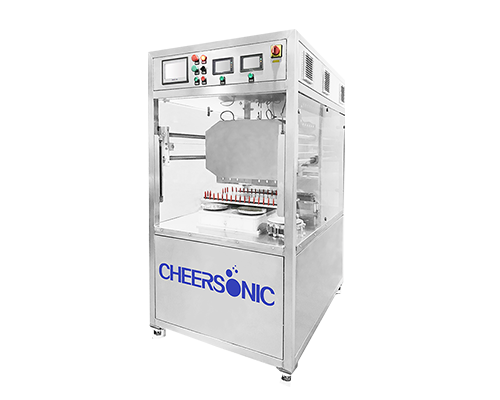
3. Wide adaptability and future prospects of technological applications
The advantages of this technology are not limited to Brownie products. It is also suitable for handling other soft, fragile or viscous foods, such as cheesecake, frozen desserts, sandwich pastries, high oil bread, and various fiber or granule rich foods. Its precise, clean, and gentle processing characteristics make it one of the key technologies for improving the quality of end products in modern high-end food manufacturing.
With the increasing demands of consumers for the appearance, taste, freshness, and safety of food, as well as the continuous evolution of the food industry towards automation and intelligence, such precision processing technologies based on new physical principles are showing great potential for development. It is not just an upgrade of cutting tools, but also represents a new production philosophy that respects the characteristics of ingredients themselves, opening up an innovative path towards higher quality and efficiency for the baking industry and even the entire food processing field.
About Cheersonic
Cheersonic manufactures the leading portioning equipment for bakeries producing fresh and frozen desserts. Since 1998 bakers have used Cheersonic machines to cut, slice and portion cheesecake, pie, layer cake, loaves, butter, cheese, pizza, sandwichs, and more. Cheersonic offers ultrasonic cutting solutions that support start-up bakeries and high production commercial facilities alike. Small standalone machines can be used in manual baking facilities and large inline robotic solutions aid in high speed production.
Cheersonic offers many ultrasonic slicing models, both inline and offline applications, with production speeds of 80 to 1,500 cakes or pies per hour.
Cheersonic’ latest offline introductions include ultrasonic cutting with or without divider inserts between each slice. This improves the quality of the cut and makes for a much better product presentation for the customer. In addition, robotic arm improves the speed, efficiency, and accuracy of the cutting process, producing professional looking products every time.
Chinese Website: Cheersonic Provides Professional Ultrasonic Cutting Solutions
