
Cut High Viscosity Dried Fruit Jelly
Cut High Viscosity Dried Fruit Jelly – Cheersonic Ultrasonic Cutting
In the field of food processing, cutting high viscosity materials has always been one of the key challenges that the industry needs to overcome, especially for freeze-dried products containing dried fruit particles. Due to the strong viscosity of the colloid itself and the inclusion of relatively hard dried fruit components inside, traditional cutting methods are often prone to problems such as sticking knives, uneven incisions, and material pulling and deformation, which not only affect the appearance of the product, but also cause a certain degree of raw material waste. Ultrasonic cutting equipment, with its unique working principle, has become an ideal choice for solving the problem of dry cutting of high viscosity jelly.
The core advantage of ultrasonic cutting equipment lies in its use of high-frequency mechanical vibration to achieve cutting operations. During equipment operation, the cutting components generate tens of thousands of high-frequency vibrations per second. This vibration can form an extremely thin air and liquid film between the cutting blade and the material at the moment of contact, effectively reducing the frictional resistance between the material and the blade and avoiding material adhesion to the blade. For high viscosity dried jelly, this cutting method can easily cut through the highly viscous colloidal parts and accurately cut through the dried fruit particles, without cutting stuttering or colloidal tearing caused by particle obstruction. The final cut is smooth and flat, which can preserve the integrity and aesthetics of the product to the greatest extent possible and meet the strict requirements of food processing for appearance quality.
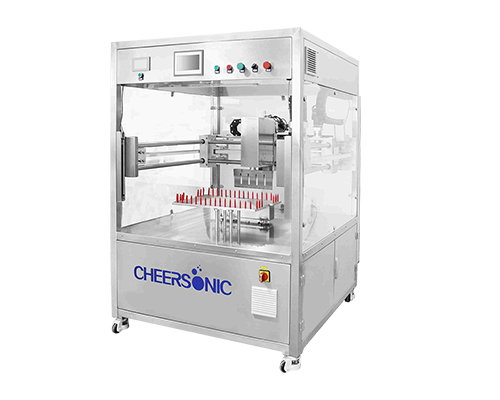
From the perspective of product specification design, the initial forming size of this type of dried jelly is set at 8 inches by 8 inches (approximately 203.2 millimeters by 203.2 millimeters when converted to millimeter units). This size planning has a clear production logic: on the one hand, the block structure of 8 inches by 8 inches is convenient for batch forming using molds. In the early processing stage, this regular large-sized block material is easier to achieve standardized production, and it is also convenient for subsequent stacking, storage, and automated transportation, reducing material loss in the circulation process; On the other hand, the large-sized block design can provide sufficient “raw material base” for subsequent cutting processes, facilitating precise control of the quantity and consistency of small-sized products after cutting.
The subsequent cutting process requires drying the 8-inch by 8-inch block shaped dry jelly and accurately cutting it into small block shaped products of 24mm by 28mm. From the perspective of size matching, each 203.2mm × 203.2mm large-size freeze-drying can cut about 8 pieces horizontally (203.2 ÷ 24 ≈ 8.46) and 7 pieces vertically (203.2 ÷ 28 ≈ 7.26), ignoring the very small cutting gap. That is, a single large-size freeze-drying can produce about 56 pieces of small-sized products. This cutting ratio can maximize the use of large-sized raw materials and reduce waste of leftover materials. The small size design of 24mm x 28mm is mainly designed to meet the needs of consumer scenarios – this size of product is moderate in size, suitable for independent small packaging, convenient for consumers to carry and consume immediately, and can also be flexibly matched into family sharing or gift box packaging to meet the sales needs of different channels.
In terms of production efficiency, the daily production target set for this processing line is 500 kilograms, which imposes clear requirements on the performance of ultrasonic cutting equipment. Firstly, the continuous operation stability of the equipment. A daily output of 500 kilograms means that the equipment needs to maintain continuous and efficient operation within a single production cycle (usually calculated based on 10-12 hours of effective working time), processing about 41-50 kilograms of material per hour. The high-frequency vibration system of the ultrasonic cutting equipment needs to have good heat dissipation performance and durability to avoid performance degradation or downtime caused by long-term operation; Next is the consistency of cutting accuracy. In mass production, the size deviation of each small product measuring 24mm x 28mm should be controlled within ± 0.5mm, otherwise it will affect the smoothness of subsequent packaging processes (such as inadequate sealing of packaging film) and the uniformity of product appearance. The precise positioning system and stable vibration frequency control equipped with ultrasonic wave cutting equipment can ensure that the size error of each cutting is within a reasonable range; In addition, the utilization rate of raw materials in the equipment also needs to meet the standard. By reducing material adhesion and corner material production during the cutting process, it ensures that the actual output of qualified products can meet the daily production target of 500 kilograms and reduce the cost of raw material loss.
In summary, using ultrasonic cutting equipment to process high viscosity dried jelly can not only solve the pain points of traditional cutting methods, but also meet the large-scale production needs of 500 kilograms per day through reasonable size design and stable equipment performance, providing efficient, accurate, and low-cost cutting solutions for food processing enterprises.
About Cheersonic
Cheersonic manufactures the leading portioning equipment for bakeries producing fresh and frozen desserts. Since 1998 bakers have used Cheersonic machines to cut, slice and portion cheesecake, pie, layer cake, loaves, butter, cheese, pizza, sandwichs, and more. Cheersonic offers ultrasonic cutting solutions that support start-up bakeries and high production commercial facilities alike. Small standalone machines can be used in manual baking facilities and large inline robotic solutions aid in high speed production.
Cheersonic offers many ultrasonic slicing models, both inline and offline applications, with production speeds of 80 to 1,500 cakes or pies per hour.
Cheersonic’ latest offline introductions include ultrasonic cutting with or without divider inserts between each slice. This improves the quality of the cut and makes for a much better product presentation for the customer. In addition, robotic arm improves the speed, efficiency, and accuracy of the cutting process, producing professional looking products every time.
Chinese Website: Cheersonic Provides Professional Ultrasonic Cutting Solutions