
Cutting Organic Silicon Composite Materials
Application and advantages of ultrasonic cutting technology in the processing of Shao A hardness organic silicon composite materials
In modern manufacturing, especially in precision medicine, automotive electronics, flexible wearable devices and other fields, organic silicon composite materials are highly favored due to their excellent biocompatibility, high and low temperature resistance, excellent electrical insulation performance and flexibility. Among them, organic silicon materials with Shore A Hardness characteristics, with their soft touch and elasticity similar to human tissue, have become the core materials of many key components. However, this unique softness and elasticity also pose significant challenges to traditional cutting processes. The emergence of ultrasonic cutting technology provides an innovative solution for efficient and precise processing of such materials.
The limitations and processing difficulties of traditional cutting techniques
Before the introduction of ultrasonic cutting technology, the industry usually used methods such as die-cutting, rotating blades, or lasers to process soft silicone composite materials. However, these methods often expose many shortcomings when facing materials with Shore A hardness:
1. Material deformation and precision loss: Mechanical blades need to apply a certain amount of positive pressure to the material during cutting. Materials with Shore A hardness are extremely soft and prone to compression, stretching, or displacement under pressure, resulting in inaccurate cutting dimensions, burrs or collapsed edges, which cannot meet the stringent requirements of high-precision products.
2. Incision adhesion and wire drawing phenomenon: Organic silicon materials have certain viscosity and toughness. During the cutting process, rotating blades or die-cutting blades are prone to generate heat or physical pulling due to friction, resulting in material melting and adhesion to the blades, or difficult to remove wire drawing. This not only affects the cutting quality, but also requires frequent shutdown and cleaning, reducing production efficiency.
3. Tool wear and lifespan issues: Even if the material hardness is not high, some organic silicon composite materials may be filled with reinforcing particles (such as silica), which can accelerate the wear of traditional tools, increase replacement frequency and production costs.
4. Cleanliness and pollution-free requirements: In medical, optical and other application scenarios, the cutting process must ensure absolute cleanliness and not produce dust, debris or chemical pollutants. The debris generated by traditional mechanical cutting and the gasification or carbonization layer that may be generated by laser cutting cannot meet such requirements.
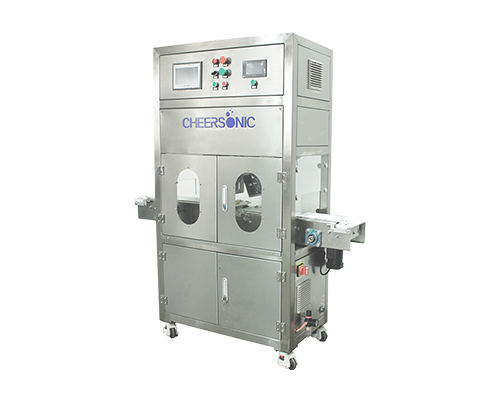
The working principle of ultrasonic cutting technology
Ultrasonic cutting technology is fundamentally different from traditional mechanical cutting. The core principle is to convert high-frequency electrical energy into mechanical vibration through a transducer. This vibration is amplified by a variable amplitude rod and transmitted to the cutting blade (die), causing it to undergo high-frequency reciprocating vibration at a frequency of tens of thousands of times per second (usually between 20kHz and 40kHz) at the microscopic level.
When this “high-speed vibration” tool comes into contact with the Shore A hardness silicone composite material, the cutting behavior undergoes a qualitative change:
*High frequency micro amplitude vibration: The amplitude of the tool is extremely small, usually between a few micrometers and tens of micrometers. This micro amplitude vibration makes the contact between the tool and the material instantaneous and high-frequency, rather than continuous and strong pressure.
*Localized energy concentration: The enormous vibration energy is highly concentrated in the extremely small area of the cutting edge, instantly breaking the binding force between material molecules and achieving “micro zone fracture” of the material.
*Friction heat effect: High frequency vibration generates friction with the interior of the material, which produces instantaneous but controllable heat in the local area of the incision. This heat can cause local instantaneous softening or micro melting of silicone materials, greatly reducing the physical pressure required for cutting.
Core advantages of applying Shao A hardness silicone composite materials
The advantages of applying ultrasonic cutting technology to such soft materials are comprehensive and significant:
1. High cutting accuracy and perfect edges: Due to the cutting process requiring almost no forward pressure, the material will not undergo compressive deformation, ensuring the accuracy of cutting dimensions. The edge of the incision is smooth, flat, and free of burrs, and the edge is instantly “fused” without fiber drawing or loosening, achieving high-quality “edge sealing” effect.
2. Chip free cleaning processing: The entire cutting process uses high-frequency vibration to “separate” the material rather than “remove” it, so there is basically no generation of chips, dust, and debris. This is crucial for maintaining the cleanliness of the work environment and avoiding product contamination, especially meeting the highest standards in the medical and optoelectronic industries.
3. Efficient and compatible with automation: Ultrasonic cutting has fast speed and clean incisions, without the need for secondary processing such as deburring and cleaning. It can be easily integrated into automated production lines to achieve high-speed, continuous and precise operations, greatly improving overall production efficiency.
4. Extend tool life and reduce maintenance costs: Due to the low cutting resistance and the high-frequency micro impact rather than continuous friction in contact with the material, the wear rate of the tool is much lower than that of traditional cutting methods. Meanwhile, its “self-cleaning” effect avoids material adhesion and reduces downtime for cleaning.
5. Wide applicability and ability to handle complex shapes: Whether it’s simple straight lines, curves, or complex irregular contours, ultrasonic cutting can easily handle them. By equipping corresponding cutting dies or combining with a multi axis motion system, various desired shapes can be accurately cut with strong flexibility.
Consideration of key process parameters
To fully leverage the advantages of ultrasonic cutting technology, several key process parameters need to be optimized and set for specific Shore A hardness silicone composite materials
*Ultrasonic frequency and amplitude: Frequency determines the speed of vibration, while amplitude determines the amplitude of vibration. For softer and more viscous materials, higher amplitudes are usually required to ensure effective separation; For slightly harder composite materials containing fillers, it may be necessary to adjust the frequency to achieve the best cutting effect.
*Cutting speed: The cutting speed must match the vibration parameters of the ultrasonic wave. Excessive speed may result in incomplete cutting and wire drawing; If the speed is too slow, it may lead to excessive heat accumulation, causing the material to overheat.
*Tool (die) design and material: The shape, blade angle, and material of the tool directly affect energy transfer efficiency and cutting quality. For different material thickness and shape requirements, it is necessary to select or customize the most suitable cutting tool.
Conclusion
In summary, ultrasonic cutting technology, with its unique high-frequency mechanical vibration principle, perfectly overcomes the accuracy, cleanliness, and efficiency bottlenecks faced by traditional cutting methods in processing Shore A hardness silicone composite materials. It provides a clean, precise, efficient, and easy to automate solution, greatly improving the quality and reliability of end products. With the increasingly stringent requirements for material processing in high-end manufacturing, ultrasonic cutting technology will undoubtedly play an increasingly important role in the precision machining of soft elastic materials, becoming one of the key processes driving the technological upgrading of related industries.
About Cheersonic
Cheersonic manufactures the leading portioning equipment for bakeries producing fresh and frozen desserts. Since 1998 bakers have used Cheersonic machines to cut, slice and portion cheesecake, pie, layer cake, loaves, butter, cheese, pizza, sandwichs, and more. Cheersonic offers ultrasonic cutting solutions that support start-up bakeries and high production commercial facilities alike. Small standalone machines can be used in manual baking facilities and large inline robotic solutions aid in high speed production.
Cheersonic offers many ultrasonic slicing models, both inline and offline applications, with production speeds of 80 to 1,500 cakes or pies per hour.
Cheersonic’ latest offline introductions include ultrasonic cutting with or without divider inserts between each slice. This improves the quality of the cut and makes for a much better product presentation for the customer. In addition, robotic arm improves the speed, efficiency, and accuracy of the cutting process, producing professional looking products every time.
Chinese Website: Cheersonic Provides Professional Ultrasonic Cutting Solutions
