
Ultrasonic Cutting Machines in Pork Floss Roll Cutting
Analysis of the Application of Ultrasonic Cutting Machines in Pork Floss Roll Cutting
In the baking food processing industry, pork floss rolls are highly favored by the market due to their rich layers, soft texture, and savory flavor. However, the cutting process, a crucial step determining the product’s appearance, taste, and yield, has long faced numerous bottlenecks with traditional cutting techniques. Ultrasonic cutting machines, with their core advantages of “high-frequency vibration + pressureless contact,” precisely adapt to the complex structural characteristics of pork floss rolls—”soft cake body + loose pork floss + soft filling”—becoming a core technological solution for improving the processing quality and efficiency of pork floss rolls.
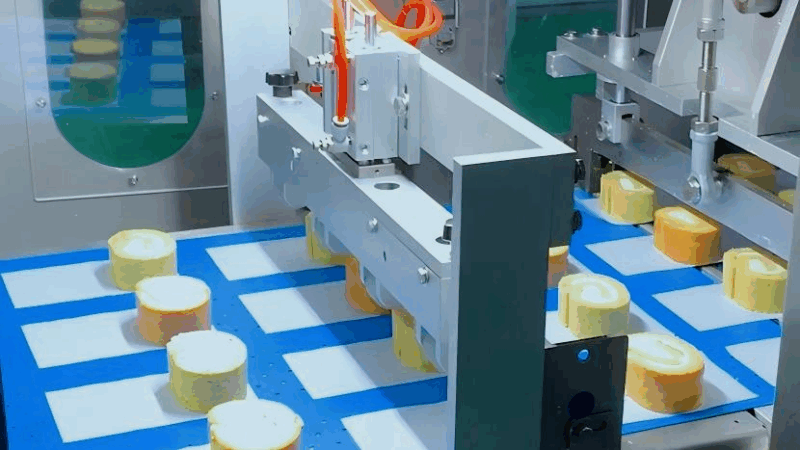
The core principle of ultrasonic cutting technology is to achieve precise separation of materials through high-frequency mechanical vibration. The equipment converts mains power into a 20-40kHz high-frequency electrical signal via a generator, which is then converted into mechanical vibration of the same frequency by a transducer. This vibration is then transmitted to the cutting head via an amplitude modulator, causing the blade to generate micron-level high-frequency vibration. This vibration creates localized high pressure at the contact point between the blade and the pork floss roll, while significantly reducing the frictional resistance of the cutting surface, achieving “pressureless cutting.” Unlike traditional mechanical cutting that relies on pressure and extrusion, ultrasonic cutting can separate the meat floss roll without damaging its internal structure, fundamentally solving the core pain point of cutting soft, complex foods.
Compared to traditional cutting methods, ultrasonic cutting machines exhibit three core advantages in cutting meat floss rolls. First, the cut is smooth and structurally intact. The cake layer of a meat floss roll is soft and porous, and the meat floss is loose and easily falls off. Traditional cutting often leads to problems such as flattening of the cake layer, meat floss falling off, and filling being squeezed out. Ultrasonic cutting, however, uses high-frequency vibration to instantly break the material fibers, resulting in a smooth, mirror-like cut. The boundaries between the cake layer, filling layer, and meat floss layer are clearly defined, without any extrusion marks, effectively ensuring product consistency. Second, it prevents sticking and is highly efficient at cleaning. The oil and sugar content of meat floss rolls easily causes traditional blades to stick, requiring frequent machine stops for cleaning, affecting production efficiency. Ultrasonic vibration creates a “micro-separation” effect between the blade and the material, preventing sticking. Simultaneously, the self-cleaning function of the vibration reduces residue residue, significantly shortening cleaning time and improving continuous production capacity. Thirdly, it is adaptable to multiple scenarios and offers precise cutting. Whether it’s room-temperature meat floss rolls or frozen and set products, the ultrasonic cutter can stably adapt. By adjusting the vibration frequency (20-30kHz for standard thicknesses, 40kHz for thin sheet cutting) and cutting speed, length errors within 0.8mm can be controlled, meeting the processing needs of products of different specifications.
In practical applications, there are three key operational points to grasp when ultrasonically cutting meat floss rolls. First, the pre-processing stage: meat floss rolls containing soft fillings such as cream and jam need to be frozen at -18℃ to -30℃ to ensure the stability of the filling structure and prevent overflow during cutting. Second, parameter matching: parameters are adjusted according to the diameter of the meat floss roll (usually 30-80mm) and its softness. Under normal circumstances, a frequency of 20-30kHz and an amplitude of 20-50μm are selected, and the cutting speed is controlled at 0.3-1.5m/min to achieve a balance between cutting force and precision. Third, equipment maintenance: the cutting head is made of food-grade stainless steel, and the surface must be regularly checked for the integrity of the Teflon non-stick coating. Parts of the equipment that come into contact with food must be disassembled and disinfected regularly according to food hygiene standards to ensure processing safety.
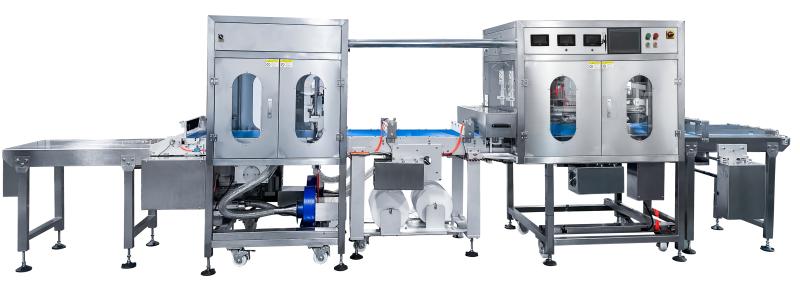
The application of ultrasonic cutting machines has significantly improved the industrialization level of meat floss roll processing. In small bakeries, tabletop equipment is compact and flexibly adaptable to small-batch, multi-variety production. In central kitchens and large processing plants, it can be linked with automated feeding and packaging equipment to form an integrated production line of “forming-freezing-cutting-packaging,” with a single-shift output of over 2,000 portions. Simultaneously, it increases the product qualification rate from 85% with manual cutting to over 98%, and reduces the waste rate from 5% to below 1.2%. This technological upgrade not only reduces labor costs and raw material waste but also enhances brand competitiveness through stable product quality.
With the development of intelligent food processing, ultrasonic cutting technology will be more widely used in meat floss roll processing. Its characteristics of “non-damaging, high precision, and high efficiency” perfectly match the modern food industry’s dual pursuit of quality and efficiency, providing reliable support for the technological upgrade of the baking industry.
About Cheersonic
Cheersonic manufactures the leading portioning equipment for bakeries producing fresh and frozen desserts. Since 1998 bakers have used Cheersonic machines to cut, slice and portion cheesecake, pie, layer cake, loaves, butter, cheese, pizza, sandwichs, and more. Cheersonic offers ultrasonic cutting solutions that support start-up bakeries and high production commercial facilities alike. Small standalone machines can be used in manual baking facilities and large inline robotic solutions aid in high speed production.
Cheersonic offers many ultrasonic slicing models, both inline and offline applications, with production speeds of 80 to 1,500 cakes or pies per hour.
Cheersonic’ latest offline introductions include ultrasonic cutting with or without divider inserts between each slice. This improves the quality of the cut and makes for a much better product presentation for the customer. In addition, robotic arm improves the speed, efficiency, and accuracy of the cutting process, producing professional looking products every time.
