
Ultrasonic Small Pound Cake Cutting Machine
Ultrasonic Small Pound Cake Cutting Machine – Cheersonic
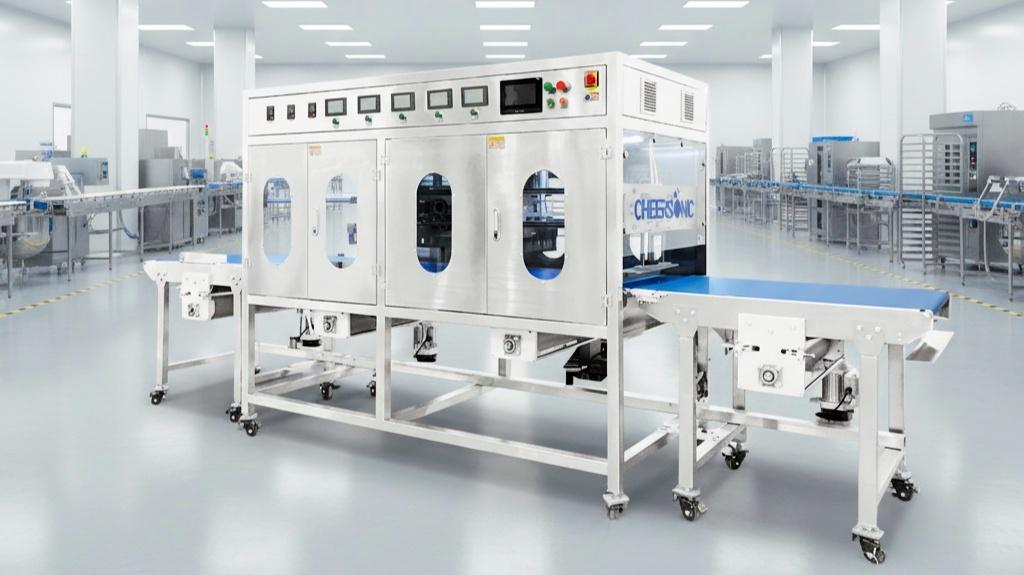
In modern food processing production lines, the precision and efficiency of the cutting process directly affect the quality of the final product and the company’s cost control. In recent years, as consumers’ demands for the appearance, taste, and uniformity of baked goods have increased, a precision cutting technology based on high-frequency vibration has gradually become a focus of industry attention. The core device corresponding to this technology is usually called an ultrasonic slicing device. This type of equipment uses an ultrasonic generator to convert electrical energy into mechanical vibration, which is then transmitted through the blade at a frequency of tens of thousands of times per minute, achieving clean and crisp slicing of soft, sticky, or loosely structured baked goods. Unlike the extrusion cutting of traditional metal blades, this vibration cutting method significantly reduces the generation of slicing debris, maintains the original shape of the cake structure, and prevents the filling layers (such as jam, cream, or chocolate) from slipping or overflowing due to force.

In practical applications targeting specific baked goods, the equipment needs to be highly compatible with the product’s dimensions. Take a popular mini pound cake as an example: its final dimensions, after repeated testing and optimization, were determined to be 85 mm in length, 69 mm in width, and 55 mm in height. These values were not arbitrarily set but rather a scientific result considering raw material costs, packaging versatility, single serving size, and visual appeal. The 85 mm length is perfectly ergonomic for an adult’s hand; the 69 mm width accommodates a classic rectangular cake mold and allows for high-density arrangement on a standard baking tray, maximizing oven space utilization; and the 55 mm height ensures sufficient expansion space during baking, resulting in a full, rounded top, and maintaining consistent thickness and weight in each slice.
When ultrasonic slicing equipment is combined with this specific pound cake size, the production line experiences a significant leap forward. First, on the automated production line, the freshly baked and cooled mini pound cakes are conveyed to the cutting station via a positioning conveyor belt. Photoelectric sensors precisely identify the length (85 mm) of each cake, and the control system then drives the vibrating blade to fall vertically according to the preset slicing thickness (e.g., 10 slices per 8.5 mm slice). Because the blade vibrates at an ultrasonic frequency, even if the cake contains large pieces of nut crumbs or candied fruit, the blade can slice through them as smoothly as a hot knife through butter, without dragging or crushing the particles. Secondly, for the 69 mm width, the equipment is usually equipped with a multi-blade parallel system, which can slice an entire row of cakes simultaneously in one stroke, greatly increasing output per unit time. As for the 55 mm height dimension, it determines the area of the cake’s side surface—sufficiently high sides allow the cut surface to display a fine texture and uniform porous structure, which is crucial for attracting consumers’ attention at the retail level.
From a maintenance and cleaning perspective, ultrasonic slicing equipment has significant advantages over traditional rotary blade slicers. Because the blade itself has a very small amplitude (typically at the micrometer level) and does not rely on the shearing force generated by high-speed rotation, cake residue is less likely to adhere to the blade surface. This is especially crucial for pound cakes with high sugar or fat content—traditional blades become coated with a sticky mixture of oil and sugar after cutting a dozen or so pieces, resulting in increasingly rough cut surfaces. The self-cleaning effect of the ultrasonic blade ensures virtually no residue on the surface after each cutting cycle, requiring only periodic rinsing with hot water or wiping with alcohol to restore cleanliness. Furthermore, the blade is made of high-strength titanium alloy or special steel, precision-machined, and maintains dimensional stability even after tens of thousands of hours of continuous vibration, eliminating the need for frequent sharpening or replacement.
The equipment is also meticulously designed to ensure food safety and compliance. All parts in contact with the cake are made of food-grade stainless steel or FDA-compliant engineering plastics, with a smooth, corner-free structure to prevent bacterial growth. Because the cutting process does not generate high temperatures (the vibration energy is extremely low, almost not converting into heat), it does not alter the physicochemical properties of the cake’s cut surface, thus preserving the product’s original flavor and moisture activity. For baking companies exporting to the EU or North American markets, this equipment easily meets the online monitoring and recording requirements of HACCP and GMP certifications because the pressure, speed, and vibration frequency of each cut are collected in real time and uploaded to a central data system, enabling full-process traceability.
Finally, from an economic perspective, using ultrasonic slicing equipment to process 85×69×55 mm mini pound cakes can bring significant returns to businesses. First, the slice loss rate is reduced from 5%-8% using traditional methods to below 1%, saving tens of tons of raw material costs annually. Second, the smooth and uniform cut eliminates the need for secondary trimming or manual sorting of defective products, saving manpower in the subsequent packaging process. Furthermore, the uniform slice thickness ensures minimal net weight deviation in each individual package, meeting regulatory requirements while avoiding profit loss due to “overweight.” Many users have reported that within six months of introducing the equipment, the benefits gained from reduced waste and increased efficiency alone covered the initial investment. In the longer term, the product’s flawless cross-section allows it to build a stronger brand image in high-end supermarkets and online e-commerce platforms, thus supporting a higher pricing strategy.
In conclusion, the use of advanced slicing equipment based on high-frequency vibration principles for pound cakes with compact dimensions of 85 mm in length, 69 mm in width, and 55 mm in height represents a crucial step for the baking industry in transitioning from extensive production to refined manufacturing. It not only solves the pain points of traditional cutting methods, such as crumbling, deformation, and misalignment of layers, but also elevates product consistency, hygiene, safety, and economy to new heights through automated and intelligent control. With consumers’ continued pursuit of the “small and beautiful” trend in baked goods and snacks, the combination of this type of equipment with standard-sized cakes will undoubtedly lead the production trend for the next five to ten years.
About Cheersonic
Cheersonic manufactures the leading portioning equipment for bakeries producing fresh and frozen desserts. Since 1998 bakers have used Cheersonic machines to cut, slice and portion cheesecake, pie, layer cake, loaves, butter, cheese, pizza, sandwichs, and more. Cheersonic offers ultrasonic cutting solutions that support start-up bakeries and high production commercial facilities alike. Small standalone machines can be used in manual baking facilities and large inline robotic solutions aid in high speed production.
Cheersonic offers many ultrasonic slicing models, both inline and offline applications, with production speeds of 80 to 1,500 cakes or pies per hour.
Cheersonic’ latest offline introductions include ultrasonic cutting with or without divider inserts between each slice. This improves the quality of the cut and makes for a much better product presentation for the customer. In addition, robotic arm improves the speed, efficiency, and accuracy of the cutting process, producing professional looking products every time.
