
Precision Slicing of Frozen Cheesecake
Precision Slicing of Frozen Cheesecake: Ultrasonic Cutting and Fan-Shaped Paper Insertion Technology
In the baking and frozen dessert processing industry, precise slicing and packaging are crucial for ensuring product quality and production efficiency. Taking a frozen cheesecake with a diameter of 20 cm and a weight of 1200 grams as an example, evenly dividing it into 12 fan-shaped pieces and simultaneously inserting paper—this seemingly simple task actually places extremely high demands on cutting precision, hygiene standards, and operational efficiency. The introduction of ultrasonic cutting technology provides an elegant and efficient solution to this process.
Slicing Challenges in Frozen Conditions
Frozen cheesecakes have unique texture characteristics. At temperatures between -18 and -25 degrees Celsius, the cake becomes hard and slightly brittle, and the internal fat and curd structure becomes uniformly dense due to ice crystal formation. Traditional metal blades often encounter several problems when cutting frozen cakes: First, the resistance is relatively high, requiring considerable pressure, which can easily cause the cake edges to crack or the bottom to crumble; second, the cut surface is prone to leaving burrs or crumbs, affecting the appearance of the finished product; third, the heated blade may cause localized thawing of the cake, resulting in sticking to the blade or blurry cuts. Furthermore, achieving a 12-part fan-shaped cut requires far more precise angle control than a simple straight cut.
The Core Principle of Ultrasonic Cutting
The working principle of ultrasonic cutting equipment lies in high-frequency vibration. The cutting head vibrates mechanically at a frequency of approximately 20,000 to 40,000 times per second with a micrometer-level amplitude. When the cutting head contacts the surface of a frozen cheesecake, the high-frequency vibration generates locally concentrated energy in the contact area. This energy instantly softens or brittles the cake material at a microscopic level, allowing the cutting head to cut smoothly with almost no downward pressure. Unlike the “compression and tearing” of traditional cutting, ultrasonic cutting is closer to “high-frequency micro-vibration decomposition”—the cutting head seems to create an extremely narrow channel within the material, significantly reducing cutting resistance.
This characteristic is especially valuable for frozen cheesecakes. Because no heavy pressure is required during cutting, the cake’s texture and structure are preserved intact, resulting in a smooth, mirror-like cut without crumbs or cracks. Simultaneously, the vibration of the cutting head itself effectively prevents material adhesion, keeping the cutting surface clean even when working with cheesecakes with high fat content, enabling continuous operation.
Slicing a 20cm Diameter, 1200g Cake into Sectors
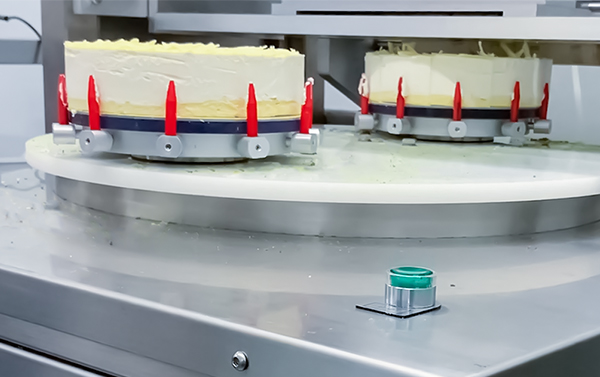
For a frozen cheesecake with a diameter of 20cm and a weight of 1200g, the cake is evenly divided into 12 sectors. This means each sector has a central angle of 30 degrees, an outer arc length of approximately 5.24cm, and a tip close to the center. To achieve this, an ultrasonic cutting system is typically equipped with a circular turntable and an angle positioning device. The operator places the frozen cake in the center of the turntable and secures its position using a positioning chuck. The cutting head is vertically mounted on a height-adjustable arm and moves radially from the outer edge towards the center.
After starting the equipment, the turntable rotates intermittently at a preset angle. After each radial cut, the turntable automatically rotates 30 degrees for the next cut. Because ultrasonic cutting is rapid and requires no pause for cleaning the blade, all 12 cuts can usually be completed within tens of seconds. The 1200g cake weight means the cake is of moderate thickness, and the ultrasonic cutting head penetrates deeply enough to make a complete cut from top to bottom in one stroke, eliminating the need for secondary cuts.
After cutting, the 12 fan-shaped pieces separate from each other, with the slit width only slightly larger than the blade thickness. The overall shape of the cake remains intact, and the pieces can be easily separated by the slits alone.
Synchronous Paper Insertion Process
Inserting paper simultaneously with or immediately after cutting is a crucial step to prevent the cake pieces from sticking together again. The paper is typically food-grade anti-stick paper or silicone paper, cut into fan or trapezoidal shapes, slightly larger than the sides of the cake pieces. There are two common process paths for paper insertion:
The first is “cut first, insert later.” After all 12 ultrasonic cuts are completed, the equipment automatically or manually pushes the paper along the slits. This method requires a certain degree of paper stiffness and shape; the paper needs sufficient rigidity to smoothly enter the narrow slits without curling.
The second is “cut and insert simultaneously.” Some ultrasonic cutting systems integrate a paper guide mechanism at the rear of the blade. As the blade advances to cut, the guide mechanism simultaneously feeds the folded paper into the newly formed slit. After the blade retracts, the paper is perfectly sandwiched between two cake pieces. This method is more efficient and ensures accurate paper positioning, preventing misalignment or excessive edge exposure.
Regardless of the method used, the final result is that each pair of adjacent fan-shaped cheesecake slices is separated by a layer of paper. When taking a slice, customers simply pinch the exposed end of the paper to easily remove it intact without damaging the shapes of adjacent slices.
Technological Advantages and Application Value
Compared to manual cutting or traditional mold cutting, ultrasonic cutting combined with automatic sheet separation technology brings significant improvements. Firstly, cutting precision—the angular deviation of 12 equal divisions can be controlled within 0.5 degrees, and the weight deviation of each piece is less than 2 grams, which is crucial for standardized packaging and cost accounting. Secondly, cut surface quality—a smooth cut surface is not only aesthetically pleasing but also reduces the cake’s contact area with air, helping to extend shelf life. Thirdly, production efficiency—a single cutting cycle can be reduced to 30 to 60 seconds, suitable for medium to large-volume production. Fourthly, hygiene and safety—ultrasonic cutting requires no lubrication, and the blade can be quickly disassembled and cleaned, meeting the cleanliness requirements of food processing.
For a 20 cm diameter, 1200 g frozen cheesecake, this process not only solves the geometric challenges of fan-shaped cutting but also seamlessly integrates the sheet separation action, achieving a smooth transformation from a whole cake to an individual packaging unit. In central kitchens, bakeries, and even automated food production lines, ultrasonic cutting technology is becoming an important tool for processing frozen cheesecake desserts. It frees cake decorators from the tedious and error-prone manual slicing, allowing them to devote more energy to recipe development and flavor innovation.
About Cheersonic
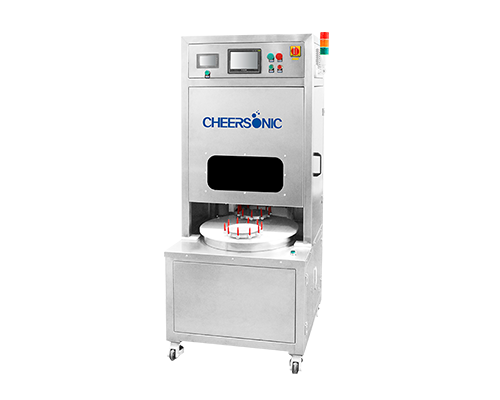
Cheersonic manufactures the leading portioning equipment for bakeries producing fresh and frozen desserts. Since 1998 bakers have used Cheersonic machines to cut, slice and portion cheesecake, pie, layer cake, loaves, butter, cheese, pizza, sandwichs, and more. Cheersonic offers ultrasonic cutting solutions that support start-up bakeries and high production commercial facilities alike. Small standalone machines can be used in manual baking facilities and large inline robotic solutions aid in high speed production.
Cheersonic offers many ultrasonic slicing models, both inline and offline applications, with production speeds of 80 to 1,500 cakes or pies per hour.
Cheersonic’ latest offline introductions include ultrasonic cutting with or without divider inserts between each slice. This improves the quality of the cut and makes for a much better product presentation for the customer. In addition, robotic arm improves the speed, efficiency, and accuracy of the cutting process, producing professional looking products every time.
