
How to Perfectly Divide Large Round Parmesan Cheese
The Precision Art of Ultrasonic Cutting: How to Perfectly Divide Large Round Parmesan Cheese
Parmesan cheese holds a special place in the dairy processing and high-end catering industries due to its firm, dense texture and rich flavor. However, this hard cheese, which undergoes a long aging process, especially large round Parmesan cheeses with a diameter of 30 to 50 centimeters and a weight exceeding 30 kilograms, presents a significant challenge to the food processing industry in the cutting process. Traditional cutting methods are not only inefficient but also struggle to achieve precise equal division and weight. The advent of ultrasonic cheese cutters has provided a revolutionary solution to this problem.
The Dilemma of Traditional Cutting
Large round Parmesan cheeses possess unique structural characteristics: a hard rind, a dense and fragile internal structure, and unevenly distributed natural crystalline particles. When cutting with ordinary knives, the enormous friction can cause the cheese to crack or break irregularly, especially when it is necessary to precisely divide the round cheese into several sectors, where the cutting deviation amplifies with the increase in radius. Traditional hand-cutting relies on the operator’s experience, which is not only labor-intensive but also makes it difficult to guarantee the consistency of weight for each piece—which means considerable economic losses for high-end Parmesan cheese priced by weight.

Working Principle of Ultrasonic Cutting
Ultrasonic cheese cutters utilize high-frequency vibration technology. The blade vibrates mechanically at a frequency exceeding 20,000 times per second with a micron-level amplitude. This high-frequency vibration produces the following effects at the blade-cheese contact surface: an air or liquid layer forms on the blade surface, significantly reducing the coefficient of friction; vibration energy is concentrated in the cutting area, causing a momentary, minute energy concentration in the cheese tissue; the rapid reciprocating motion of the blade creates a “micro-saw” effect, rather than simple compression cutting.
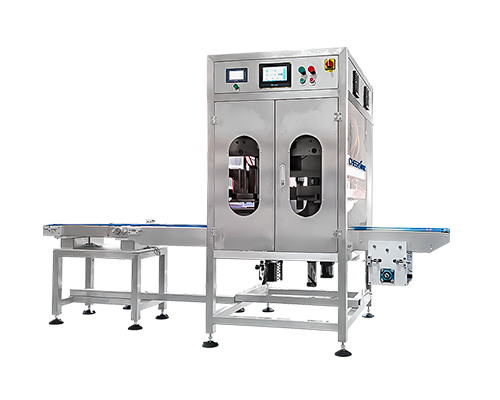
When this technology is applied to the equal-slicing of large-sized round Parmesan cheese, the operation process typically follows these steps: The cheese is first fixed on a rotating worktable, and the center position is determined by a laser or mechanical positioning system; the control system calculates the angle of each cutting line based on the preset number of equal slices (e.g., 6, 8, or 12 slices); the ultrasonic blade moves radially outward from the center, or cuts inward from the outer edge, completing one full cut before automatically rotating to the next angle; this process is repeated until all equal slices are completed.
Key Factors for Achieving Equal Slicing and Weight
To achieve ideal equal-slicing and weighting, several key factors are indispensable. The choice of blade geometry is crucial—for large, round cheeses, wedge-shaped or fan-shaped blades better accommodate the thickness variations from the center to the outer edge. Optimizing vibration parameters requires adjustment based on the cheese’s temperature and aging process; there are significant differences in cutting parameters between refrigerated Parmesan (approximately 4-8°C) and room temperature Parmesan. Matching the cutting speed with the feed rate determines the smoothness of the cut; too fast a speed may result in a rough surface, while too slow a speed reduces efficiency. The precision of the automated control system directly determines the accuracy of angle repeatability; high-end equipment can control angular errors within 0.1 degrees.
Technological Advantages and Practical Benefits
Compared to traditional cutting methods, ultrasonic technology demonstrates several advantages in processing large, round Parmesan cheeses. In terms of cutting precision, weight errors can be controlled within ±1%, far superior to the ±5% of manual cutting. The cut surface is smooth and free of debris, reducing cutting losses by approximately 80%. In terms of cutting efficiency, one machine can complete the 12-part cut of a 40cm diameter cheese in 2-3 minutes, equivalent to 15 minutes of work for a skilled worker. Furthermore, due to extremely low frictional heat generation, the cheese’s texture does not melt or change due to high temperatures, fully preserving Parmesan’s characteristic granular, crystalline texture.
From a commercial perspective, the standardization advantages of equal-weight cutting are significant. Restaurant chains can obtain consistent cheese portions, simplifying cost accounting and standardizing menu processes. Retail packaging allows for precise weight control, reducing lost profit margins due to overweight products. For high-end cheese producers, providing customers with neatly shaped, perfectly cut products is itself a reflection of brand value.
Conclusion
The ultrasonic cheese cutter cleverly combines precision vibration technology with the needs of food processing, solving the long-standing technical challenge of equally dividing and weighing large-sized round Parmesan cheeses. It not only improves production efficiency but, more importantly, ensures consistent quality for every product through precise control. In today’s food processing landscape, which increasingly pursues standardization and automation, this technology is redefining the processing standards for hard cheeses, injecting the traditional cheese industry with the precision and efficiency of modern engineering.
About Cheersonic
Cheersonic manufactures the leading portioning equipment for bakeries producing fresh and frozen desserts. Since 1998 bakers have used Cheersonic machines to cut, slice and portion cheesecake, pie, layer cake, loaves, butter, cheese, pizza, sandwichs, and more. Cheersonic offers ultrasonic cutting solutions that support start-up bakeries and high production commercial facilities alike. Small standalone machines can be used in manual baking facilities and large inline robotic solutions aid in high speed production.
Cheersonic offers many ultrasonic slicing models, both inline and offline applications, with production speeds of 80 to 1,500 cakes or pies per hour.
Cheersonic’ latest offline introductions include ultrasonic cutting with or without divider inserts between each slice. This improves the quality of the cut and makes for a much better product presentation for the customer. In addition, robotic arm improves the speed, efficiency, and accuracy of the cutting process, producing professional looking products every time.
