
Ultrasonic Cheese Cutting Machine of Cheddar Cheese
Ultrasonic Cheese Cutting Machine: Precisely Solving the Problem of Equal Slicing and Weighting of Cheddar Cheese
In the dairy processing industry, cheddar cheese is highly sought after for its dense texture and unique flavor. However, this very density presents a significant challenge in the cutting process. Traditional cutting methods often struggle to balance efficiency and precision. The emergence of the ultrasonic cheese cutting machine provides an ideal solution for the equal sliceing and weighting of cheddar cheese.
The Cutting Dilemma of Cheddar Cheese
Cheddar cheese is a hard or semi-hard cheese. After long periods of pressing and aging, its internal structure is dense, its texture uniform, yet it is very tough. Using traditional wire cutters or blades often encounters several problems: first, the cutting resistance is high, easily causing the cheese blocks to deform or crumble; second, the cut surface is not smooth enough, producing more debris and wasting raw materials; third, it is difficult to ensure that each slice has a consistent thickness and weight, especially in high-speed continuous production, where deviations are more pronounced.
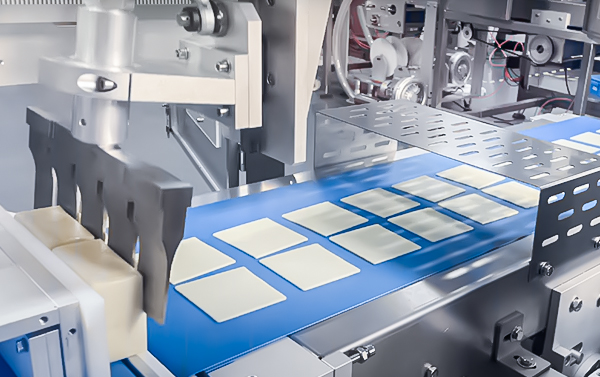
For food processing companies, equal cutting and weighing is not only a production standard requirement, but also directly related to product packaging, cost control, and brand image. Even a 1-gram error in cutting a 15-gram slice of cheese can accumulate into considerable economic losses. Therefore, finding a technology that can guarantee cutting quality while improving production efficiency has become a common demand in the industry.
The Working Principle of Ultrasonic Cutting
The core of an ultrasonic cheese cutter lies in high-frequency vibration. The cutting head vibrates at a frequency of over 20,000 times per second with minute amplitudes. This vibration causes localized energy accumulation at the moment the blade contacts the cheese. The blade doesn’t simply “squeeze” through the cheese; instead, the high-frequency vibration creates a tiny cavitation effect inside the cheese, significantly reducing frictional resistance.
In short, hard cheese that the blade can’t “push” open can be “pushed aside” by vibration. During cutting, the cheese experiences minimal compressive force, making it less prone to deformation and breakage. Cheddar cheese, which normally requires considerable pressure to cut, can be cut with just a light touch using ultrasonic cutting, resulting in a clean, crisp cut and significantly reduced debris.
Key Technologies for Achieving Equal Slicing and Weight
To achieve equal slices and weights, ultrasonic vibration alone is insufficient; a sophisticated control system is also required.
First, a servo-driven positioning system is crucial. After the cheese block enters the cutting station, the system precisely measures its length or volume using sensors and automatically calculates the cutting position for each slice based on the preset number of slices or weight per slice. For cheese blocks with irregular shapes, modern equipment is also equipped with laser or vision inspection devices, enabling real-time adjustment of cutting parameters to ensure uniform thickness for each slice.
Second, closed-loop control with the weighing system is essential. A high-precision online weighing module quickly detects the weight of each slice after cutting. If a deviation trend is detected, the control system automatically corrects subsequent cutting thickness or feed rate, achieving dynamic adjustment. This ensures that even with slight fluctuations in the density of the incoming cheese, each slice maintains a highly consistent weight.
Furthermore, matching the cutting speed with the vibration frequency is critical. The characteristics of cheddar cheese mean that different batches and different aging times will result in variations in hardness. The ultrasonic generator automatically adjusts its frequency to match the damping characteristics of the cheese, ensuring smooth cutting without overheating—overheating can cause the cheese surface to melt or oil to separate, affecting appearance and taste.
Advantages Compared to Traditional Methods
Compared to traditional rotary or punching methods, ultrasonic cheese cutters offer several advantages when processing cheddar cheese:
Superior Cut Quality: Smooth, flat cuts without burrs or crumbs, resulting in uniform cheese slices that meet high-end packaging requirements.
High Weight Accuracy: With servo control and weighing feedback, the weight error of a single slice can be controlled within a minimal range, meeting production standards for equal division and weight.
Reduced Raw Material Waste: Significantly reduced crumbs and scraps, increasing cheese utilization by several percentage points.
Easy Cleaning and Maintenance: The ultrasonic cutter head has a self-cleaning effect, preventing cheese from adhering to the blade and reducing the frequency of cleaning shutdowns.
Highly adaptable: It can handle both hard Cheddar under refrigeration and semi-soft Cheddar after it has warmed up, and the equipment parameters can be flexibly adjusted.
Practical Considerations
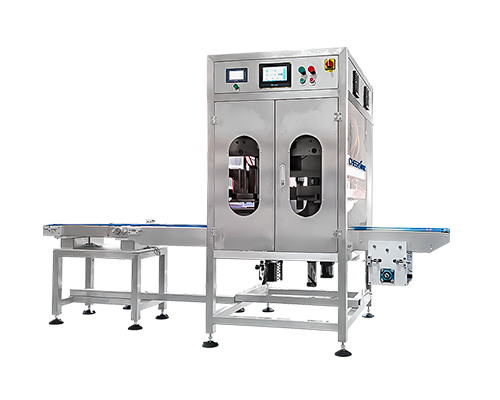
In actual production, several aspects need attention when using an ultrasonic cheese cutter to cut cheddar cheese: the pretreatment temperature of the cheese should be kept relatively stable, as excessive temperature fluctuations will affect the consistency of the cut; the amplitude and frequency of the cutter head should be checked regularly to ensure they are within the standard range; and the appropriate cutter head width and shape should be selected according to production needs (rectangular or fan-shaped cutters are suitable for cheese blocks of different sizes).
Conclusion
The ultrasonic cheese cutter, through the combination of high-frequency vibration and intelligent control, effectively solves the problem of equal division and weighting in cheddar cheese cutting. It retains the continuity advantage of traditional cutting methods while achieving breakthroughs in precision, quality, and raw material utilization. For modern cheese processing enterprises pursuing standardization and large-scale production, this technology has become an important tool for enhancing product competitiveness. With further improvements in automation, the application prospects of ultrasonic cutting in the dairy industry will be even broader.
About Cheersonic
Cheersonic manufactures the leading portioning equipment for bakeries producing fresh and frozen desserts. Since 1998 bakers have used Cheersonic machines to cut, slice and portion cheesecake, pie, layer cake, loaves, butter, cheese, pizza, sandwichs, and more. Cheersonic offers ultrasonic cutting solutions that support start-up bakeries and high production commercial facilities alike. Small standalone machines can be used in manual baking facilities and large inline robotic solutions aid in high speed production.
Cheersonic offers many ultrasonic slicing models, both inline and offline applications, with production speeds of 80 to 1,500 cakes or pies per hour.
Cheersonic’ latest offline introductions include ultrasonic cutting with or without divider inserts between each slice. This improves the quality of the cut and makes for a much better product presentation for the customer. In addition, robotic arm improves the speed, efficiency, and accuracy of the cutting process, producing professional looking products every time.