
About Ultrasonic Cutting of Parmesan Cheese
In the field of modern food processing, the advancement of cutting technology is of great significance for ensuring product quality and improving production efficiency. Among them, ultrasonic cutting technology, as an innovative processing method, has shown significant advantages in the processing of various food materials in recent years. This article will take a classic hard mature dairy product as an example to explore the principle, characteristics, and specific application value of ultrasonic cutting technology in the processing of such products.
Basic principles of ultrasonic cutting technology
Ultrasonic cutting is a non-traditional machining technique that utilizes high-frequency mechanical vibration energy for material separation. The core component is the transducer, which converts electrical energy into high-frequency mechanical vibration and transmits the vibration to the material being cut through the blade part. When the vibration frequency exceeds 20kHz, the cutting head will produce high-frequency vibrations at the microscopic level, which can generate instantaneous energy accumulation at the contact point, quickly breaking the bonds between material molecules and achieving precise cutting. Unlike traditional cutting methods that rely on mechanical pressure, this technology achieves separation through energy vibration, significantly reducing cutting resistance.
The cutting challenge of hard dairy products
Taking a traditional hard cheese produced in the northern region of Italy as an example, this type of product undergoes a long-term aging process, has a low moisture content (usually less than 30%), and has a hard and fragile texture. When using traditional cutting methods, there are three main challenges: firstly, mechanical pressure can easily cause cracks or breakage in the product, affecting the yield rate; Secondly, the debris generated during the cutting process can cause waste of raw materials; Furthermore, frequent use of traditional cutting tools can generate frictional heat, which may affect the preservation of flavor compounds in the product. These characteristics make this type of hard dairy product one of the more difficult materials to handle in food processing.
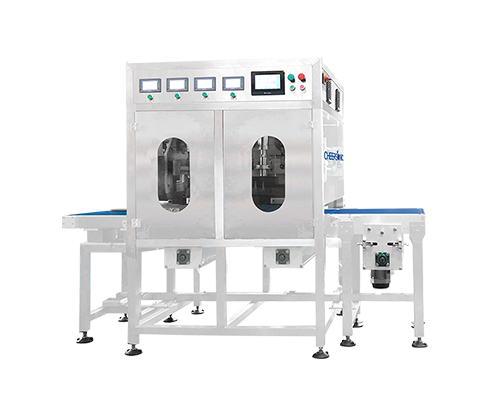
The application advantages of ultrasonic technology
When using ultrasonic cutting technology to process hard dairy products, it exhibits significant advantages in multiple aspects:
1. Improved cutting accuracy: High frequency vibration enables the blade to penetrate materials with minimal resistance, achieving sub millimeter cutting accuracy and maintaining product integrity
2. Improvement of cross-sectional quality: Vibration cutting generates very little heat, avoiding material melting or denaturation. The cutting surface is smooth and flat, with no debris generated
3. Enhanced hygiene performance: Ultrasonic vibration has a self-cleaning effect, which can effectively prevent material adhesion and comply with food processing hygiene standards
4. Improved production efficiency: The cutting speed has increased by about 40% compared to traditional methods, and there is no need for frequent downtime to clean the tools
5. Product loss reduction: Experimental data shows that using this technology can reduce the product loss rate from the traditional 8% to below 2%
Technical Implementation Plan
In practical applications, ultrasonic cutting systems typically consist of three main modules: a high-frequency generator providing power support, a transducer group achieving energy conversion, and specialized cutting tools customized according to product characteristics. For dairy products with high hardness, a vibration frequency range of 20-40kHz is usually used, with the blade amplitude controlled between 10-50 μ m. To ensure the cutting effect, parameter optimization should be carried out based on the specific hardness, oil content, and temperature conditions of the product. The supporting conveyor system needs to ensure stable positioning of the product during the cutting process, thereby ensuring consistency in cutting accuracy.
Quality Control and Industry Impact
After adopting ultrasonic cutting technology, the product quality has been improved in many aspects: the consistency of slice size has been significantly improved, and the appearance of the product is more regular; Due to avoiding compression deformation, the internal texture is better maintained; Reducing the contact area with cutting tools reduces the risk of microbial cross contamination. These improvements not only extend the product shelf life, but also enhance the consumer experience. The application of this technology has promoted the technological upgrading of the dairy processing industry and provided new possibilities for the development of high value-added products.
Future Development Trends
With the continuous improvement of processing accuracy and efficiency requirements in the food industry, ultrasonic cutting technology will continue to develop towards intelligence. The intelligent cutting equipment with integrated visual recognition system has started pilot application, which can automatically recognize product features and adjust cutting parameters. In terms of sustainable development, this technology can significantly reduce raw material waste and is in line with the concept of green manufacturing. In addition, the trend towards miniaturization of devices makes it possible for this technology to extend to the retail end, providing a new way for specialty food stores to showcase their products.
In summary, ultrasonic cutting technology provides an innovative solution to the processing difficulties of hard dairy products. By using high-frequency vibration energy to achieve material separation, this technology not only excels in cutting accuracy, product yield, and hygiene and safety, but also provides technical support for the modernization transformation of the traditional food processing industry. With the continuous improvement of related technologies and cost optimization, this innovative processing method is expected to be promoted and applied in more food fields, bringing new development opportunities to the entire industry.
About Cheersonic
Cheersonic manufactures the leading portioning equipment for bakeries producing fresh and frozen desserts. Since 1998 bakers have used Cheersonic machines to cut, slice and portion cheesecake, pie, layer cake, loaves, butter, cheese, pizza, sandwichs, and more. Cheersonic offers ultrasonic cutting solutions that support start-up bakeries and high production commercial facilities alike. Small standalone machines can be used in manual baking facilities and large inline robotic solutions aid in high speed production.
Cheersonic offers many ultrasonic slicing models, both inline and offline applications, with production speeds of 80 to 1,500 cakes or pies per hour.
Cheersonic’ latest offline introductions include ultrasonic cutting with or without divider inserts between each slice. This improves the quality of the cut and makes for a much better product presentation for the customer. In addition, robotic arm improves the speed, efficiency, and accuracy of the cutting process, producing professional looking products every time.
Chinese Website: Cheersonic Provides Professional Ultrasonic Cutting Solutions
