
Application of Ultrasonic Cutting Machines in Bread Slicing
In the industrial production of bread, the quality and efficiency of the slicing process directly affect product competitiveness. Traditional mechanical cutting methods often result in problems such as severe crumb shedding, slice deformation, and a compacted texture when used with soft, porous bread. Ultrasonic cutting machines, with their unique high-frequency vibration cutting principle, precisely solve the industry pain points of slicing soft bread, becoming a key technological equipment for improving bread processing quality.
The core advantage of ultrasonic cutting machines in bread cutting stems from their innovative working principle. Unlike traditional knives that rely on physical compression to cut ingredients, this device uses a built-in generator to convert electrical energy into a 20-40kHz high-frequency electrical signal. This signal is then converted into mechanical vibration by a transducer, amplified by an amplifier, and transmitted to the cutting head, causing the cutting head to produce tens of thousands of micro-amplitude reciprocating movements per second. This high-frequency vibration can quickly destroy the gluten network and porous structure inside the bread, achieving “separation cutting.” Throughout the process, the contact pressure between the cutting head and the bread is extremely low, fundamentally avoiding the compression damage of traditional cutting.
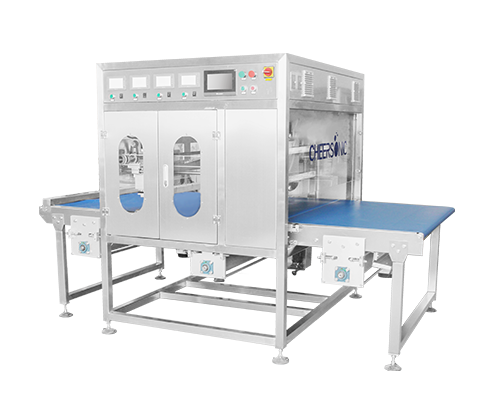
Ultrasonic cutting exhibits four core advantages for the soft and easily deformable characteristics of bread. First, it significantly reduces crumb waste. Traditional bread cutting typically produces 10%-15% crumbs, while ultrasonic cutting generates only trace amounts of powder, effectively reducing raw material loss and improving business efficiency. Second, it produces uniform and consistent slice shapes. Pressureless cutting avoids deformation issues such as bread edge collapse and dents, ensuring the slices maintain a complete rectangular shape for easy automated stacking and packaging. Third, it offers precise and controllable thickness. With servo motors and sensors, slice thickness can be flexibly adjusted within the range of 3-20mm, with errors strictly controlled within ±0.5mm, accurately catering to different consumer needs such as thick-cut sandwiches and thin-cut breakfast toast. Fourth, it preserves the original texture and flavor. Vibration cutting does not damage the porous structure of the bread, avoiding the “compacting and hardening” problem caused by traditional cutting, allowing the slices to maintain their soft and fluffy original texture.
To fully leverage the advantages of ultrasonic cutting, key application points should be noted. Matching the bread’s condition is crucial. It must be completely cooled to a core temperature of 25-28℃ before cutting. Hot bread, due to its unstable structure, may deform slightly even when cut with ultrasound. Parameter adjustments must be adapted to different bread textures. For soft white toast, the vibration frequency and cutting speed can be appropriately reduced to avoid excessive vibration damaging the structure; while for slightly firmer whole wheat toast, the frequency needs to be increased to enhance cutting force. Regarding equipment maintenance, debris should be cleaned promptly from the blade and the gaps in the equipment after cutting to prevent residue from affecting vibration efficiency or breeding bacteria. After long-term use, the flatness of the blade should be checked, and it should be replaced promptly if deformation or cracks appear to ensure stable cutting accuracy.
Ultrasonic cutting machines have a specific application scenario in bread processing, especially suitable for porous, soft bread types such as toast (white toast, whole wheat toast, multigrain toast), soft dinner rolls, and prepared bread. These types of bread suffer the greatest loss and are the most difficult to control in quality when cut using traditional methods. The application of ultrasonic technology significantly improves the standardization of products. It’s important to note that for hard European-style breads, baguettes, and other dense, hard-textured products, ultrasonic cutting is less efficient due to their hard crust and large, compact internal pores. Specialized hard bread slicing equipment is more suitable for these types of breads.
As the food industry demands higher quality and efficiency, ultrasonic cutting technology is driving the transformation and upgrading of the bread processing industry. It not only solves many pain points of traditional cutting but also, with its high-efficiency continuous operation capability, adapts to different scales of needs, from small and medium-sized bakeries to large production lines, achieving cutting speeds of 80 to 1500 products per hour. Simultaneously, the equipment’s self-cleaning characteristics reduce the risk of food sticking and cross-contamination, meeting stringent hygiene standards in food processing. In the future, with continuous optimization of parameter adaptability, ultrasonic cutting technology will show even broader application prospects in the bread processing field.
About Cheersonic
Cheersonic manufactures the leading portioning equipment for bakeries producing fresh and frozen desserts. Since 1998 bakers have used Cheersonic machines to cut, slice and portion cheesecake, pie, layer cake, loaves, butter, cheese, pizza, sandwichs, and more. Cheersonic offers ultrasonic cutting solutions that support start-up bakeries and high production commercial facilities alike. Small standalone machines can be used in manual baking facilities and large inline robotic solutions aid in high speed production.
Cheersonic offers many ultrasonic slicing models, both inline and offline applications, with production speeds of 80 to 1,500 cakes or pies per hour.
Cheersonic’ latest offline introductions include ultrasonic cutting with or without divider inserts between each slice. This improves the quality of the cut and makes for a much better product presentation for the customer. In addition, robotic arm improves the speed, efficiency, and accuracy of the cutting process, producing professional looking products every time.
