
Automatic Cutting Devices in Dog Chew Extrusion Lines
Automatic cutting devices in dog chew extrusion lines are indeed gradually upgrading from traditional mechanical or hot cutting methods to ultrasonic cutting technology. This technological transition not only improves product quality and production efficiency, but also meets the food processing industry’s demand for clean and intelligent processes. The following analysis focuses on the technical principles, comparative advantages, current applications, and industry trends:
Technical Principle: The Core Mechanism of Ultrasonic Cutting
Ultrasonic cutting utilizes high-frequency vibration energy to separate materials at the molecular level. The process works as follows:
1. Energy Conversion: An ultrasonic generator converts 50/60 Hz current into 20–40 kHz high-frequency electrical energy, which is then converted into mechanical vibrations by a transducer.
2. Vibration Transmission: An amplitude modulator transmits the vibrations to the cutting blade, where the amplitude is amplified and applied to the surface of the dog chew.
3. Low-Temperature Cutting: High-frequency vibrations break the molecular chains of the colloid, enabling rapid cutting. The process generates virtually no heat (less than 50°C), preventing charring of the material.
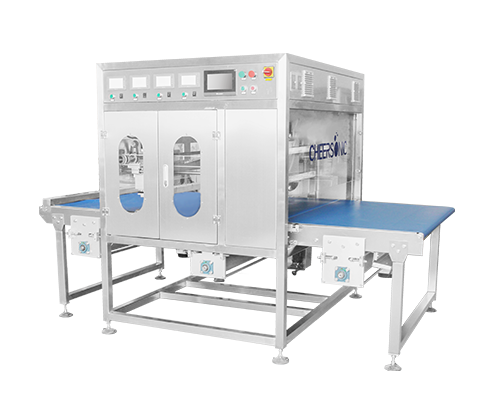
A typical system consists of an ultrasonic generator, a transducer, an amplitude modulator, and a cutter, supporting fully automated integration into production lines.
Specific Application Scenarios in Dog Chew Production
1. In-Line Cutting After Extrusion
After extrusion and initial cooling, the dog chew is straightened and conveyed by a traction mechanism (e.g., a belt roller assembly + guide plate). The ultrasonic cutter then precisely cuts the chew to the set length. A support mechanism (support plate + limit plate) is added to prevent jitter during cutting and ensure the straightness of the finished product.
2. Cutting Complex Shapes
For special-shaped chews such as twisted or two-color sandwich shapes, the ultrasonic cutter can achieve three-dimensional cutting through mold adaptation (e.g., replacing the amplitude modulator), eliminating the deformation problems associated with traditional cutting tools.
3. Film-Free Heading Process
The fully automatic equipment directly ultrasonically shapes and seals the end of the rope, eliminating the traditional film lamination step and reducing auxiliary material costs by over 20%.
Industry Adoption Drivers and Future Trends
1. Policy and Market Demand Drivers
– Stricter environmental regulations: Volatiles generated by traditional hot cutting are restricted, making ultrasonic technology a compliant option due to its “smoke-free” processing.
– Premium pet food: Consumers demand a more consistent appearance in chews, and the smoothness of ultrasonic cuts meets these quality demands.
2. Significant Economic Benefits
– Production line examples show that ultrasonic cutting machines can triple the number of devices managed per person (one person can monitor multiple devices).
– The equipment investment has a short payback period (approximately 1–2 years), resulting in long-term savings in tool and energy costs.
3. Technology Iteration Directions
– Intelligent Integration: Ultrasonic cutting modules, combined with PLC control and visual inspection, achieve a length error of ≤0.3%.
– Modular Design: Manufacturers have introduced interchangeable blade systems to accommodate different materials (e.g., starch-based and leather-based chews).
Conclusion
With its three advantages: high cut quality, environmental friendliness and energy efficiency, and strong adaptability, ultrasonic automatic cutting technology is rapidly replacing traditional cutting methods and becoming a core option for upgrading dog chew production lines. With the development of modularization and intelligent control technology in the future, its application scenarios will be further expanded to the more complex field of pet food processing. For equipment manufacturers, integrating ultrasonic cutting units has become a key path to improving the competitiveness of production lines.
About Cheersonic
Cheersonic manufactures the leading portioning equipment for bakeries producing fresh and frozen desserts. Since 1998 bakers have used Cheersonic machines to cut, slice and portion cheesecake, pie, layer cake, loaves, butter, cheese, pizza, sandwichs, and more. Cheersonic offers ultrasonic cutting solutions that support start-up bakeries and high production commercial facilities alike. Small standalone machines can be used in manual baking facilities and large inline robotic solutions aid in high speed production.
Cheersonic offers many ultrasonic slicing models, both inline and offline applications, with production speeds of 80 to 1,500 cakes or pies per hour.
Cheersonic’ latest offline introductions include ultrasonic cutting with or without divider inserts between each slice. This improves the quality of the cut and makes for a much better product presentation for the customer. In addition, robotic arm improves the speed, efficiency, and accuracy of the cutting process, producing professional looking products every time.
Chinese Website: Cheersonic Provides Professional Ultrasonic Cutting Solutions
