
Basic Knowledge of Mousse Cake!
1. About Mousse Cake
Mousse cake comes from the transliteration of the English word “mousse cake” and is a non baked dessert. Its basic ingredients include cream, gelatin, egg yolk, and sugar, presenting a creamy texture as a whole. In fact, this type of dessert itself does not contain flour, so strictly speaking, it does not belong to the traditional sense of cake. However, in order to enhance the taste, cake layers are usually added in the middle and bottom to form a multi-layered combination. This combination not only reduces the greasy feeling of simple custard, but also brings a richer taste experience.
2. Origin and Development
Mousse cake was first born in Paris, France. At that time, pastry chefs added ingredients to the cream that could enhance stability, improve taste and flavor, resulting in a rich variety of changes in appearance, color, structure and taste of the finished product, making it more natural and pure. After being refrigerated, it has a better flavor and is gradually known as the top grade dessert.
Its appearance conforms to people’s pursuit of exquisite, fashionable, and natural health lifestyle concepts, and also meets the public’s expectations for constantly upgrading desserts. Meanwhile, mousse cake also provides a vast creative space for pastry chefs, who express their insights into life and artistic inspiration through the production process.
In the world-class pastry competition, the competition for this type of dessert is particularly fierce, and its production level not only reflects the professional ability of the contestants, but also reflects the mainstream trend of current dessert development.
3. Main flavor types
- Fruit flavor
Made primarily from fresh fruits, puree, juice, or fruit pellets. Soft fruits such as strawberries, mangoes, and peaches are commonly used as fillings. Decorations often use surface coating or sandblasting techniques, with fresh fruit accents on the surface, and sometimes jelly is added to enhance the richness of the taste. - Cheese flavor
Add different flavors of cheese to the jelly to create a unique milky aroma. The most representative one is tiramisu – it is based on finger biscuits, blending the aroma of coffee and coffee liqueur, with a smooth mixture of cheese, egg, fresh cream, and sugar sandwiched in between, sprinkled with cocoa powder on the surface, and has a rich and delicate taste. - Chocolate flavor
Chocolate gives milk jelly a delicate and silky texture. The surface is usually decorated with sandblasting or coating, and paired with chocolate accessories. The pure cocoa aroma complements the light texture, resulting in a balanced and soft overall taste.
Choosing high-quality dark chocolate in moderation not only reduces the feeling of sweetness and greasiness, but also has certain health benefits. The polyphenolic components it contains help prevent fat from accumulating in blood vessels. - Nut flavor
Grind roasted nuts into powder or add nut sauce to jelly, sometimes embedding whole nuts as a filling. Surface decoration is often paired with chocolate accessories and crushed nuts to highlight the unique aroma of nuts.
One of the most representative works is Mont Blanc, whose design inspiration comes from the snow covered Mont Blanc in France. It has an elegant appearance and a fragrant flavor. - Tea aroma flavor
Mixing different types of tea into custard to create a flavor with Eastern characteristics. The traditional method is to boil tea leaves together with milk to extract the tea aroma, while modern times use more tea powder directly. Among them, matcha flavor is particularly common in the market. - Tapai flavor
Fill edible tower shells or pie bases with custard or other fillings. This form originated in ancient Rome, where it was made by simply pouring milk jelly into cookies or pies, and decorating them with seasonal fruits or chocolate accessories.
4. Analysis of commonly used raw materials
- Milk: Provides basic moisture, enhances taste and quality. If water is used instead, the flavor and texture will be greatly reduced, and it is easy to produce ice residue after freezing.
- Light cream: Adding natural frankincense to make the taste more delicate. It is generally recommended to use animal based cream, which has a high fat content and better flavor.
- Gelatin: As a commonly used coagulant, it is divided into two types: sheet and powder, which play a role in stabilizing the structure.
-The dissolution temperature is about 60 ℃, and excessive temperature can affect the coagulation effect.
-The solidification temperature is between 10-15 ℃, so the finished product can be shaped without freezing.
(Common conversion: One piece of gelatin is about 2.5-3 grams, and one tablespoon of gelatin powder is about equal to 4 pieces of gelatin or 12 grams.) - Sugar: Enhances delicacy and elasticity, and its moisture absorption helps maintain the moisture content of the finished product.
- Eggs: Egg yolks have good coagulation and emulsification effects, which can enhance texture stability and regulate elasticity. Among them, phospholipids play a crucial balancing role.
- Fruit puree: endows different flavors with a refreshing taste. If using fruit puree with strong acidity (such as mango), it is recommended to heat it first to reduce acidity.
- Alcoholic beverages: Adding a small amount (such as 10 milliliters of rum or brandy) can enhance flavor and sterilize egg yolks. If making a children’s version, this step can be omitted.
It is recommended to store the finished product in an environment of 2-4 ℃. The texture is softer than pudding and melts in the mouth.
5. Introduction to common base materials
- Italian protein cream: It is made by pouring boiled syrup into the protein and whipping it. It has a light taste and is suitable for use as a milk jelly base or macaron.
- Bomb batter: Mix hot syrup into egg yolks and beat, resulting in a bright color and a rich and deep texture. It is suitable for use on cream bases or ice cream.
- English cream sauce: made by mixing sugar with egg yolks and adding hot milk, using the coagulation power of egg yolks to increase thickness, with both refreshing and mellow characteristics. It can be used for milk jelly, ice cream, etc.
6. Material matching and common problems
Raw materials can be roughly divided into two categories:
A. Whip light cream to 50-70% (sometimes using Italian protein cream)
B. Fruit puree, gelatin, fruits, milk, cheese, egg yolks, etc
When mixing A and B, it is necessary to ensure that their concentrations are similar. The B material is relatively thin when it is just cooked. It can be mixed with ice water and cooled down until it thickens (be careful not to solidify). This is the best time for mixing.
After the finished product is refrigerated and shaped, it can be coated with pectin on the surface and decorated with fruits, chocolates, and other decorations. It is also recommended to brush the surface of fruits with pectin to retain moisture and enhance luster, improving appearance and taste.
Attention should be paid during production: mixing fresh cream directly with fruit puree or fruits containing fruit acid can easily cause clumping and hardening. It is recommended to boil the puree or fruit to reduce acidity, and then mix it with cream to ensure that the finished product has a delicate taste and melts in the mouth.
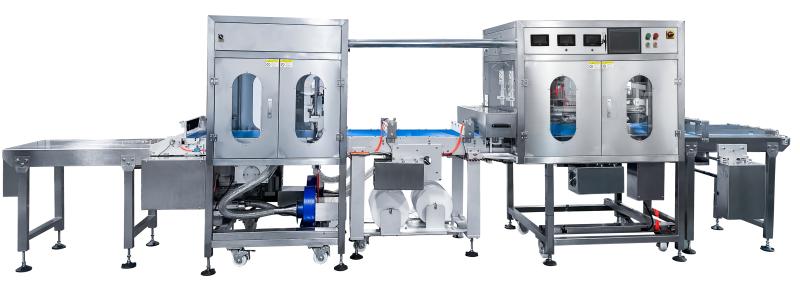
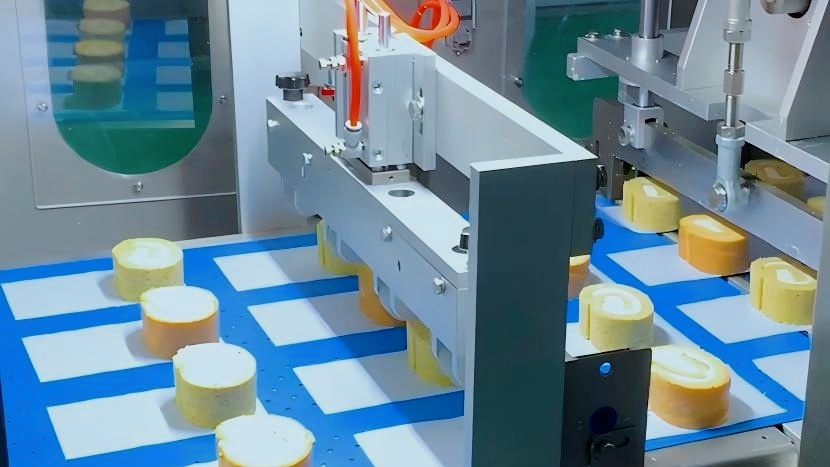
UFM2500P ultrasonic swiss roll cutting packaging machine is an advanced equipment integrating ultrasonic cutting technology and automatic packaging technology. It utilizes the high-frequency vibration of ultrasound to generate small vibrations between the cutting tool and food materials, thereby achieving fast and accurate cutting. At the same time, the device is also equipped with an automated packaging system, which can automatically complete the packaging of Swiss rolls according to preset parameters. It not only improves the cutting efficiency and accuracy of Swiss rolls, but also ensures the hygiene, safety, and production efficiency of food.
- Average speed: about 1800-3600 pieces per hour
- Color touch screen with User friendly interface
- Reliable and durable ultrasonic machine
- Increased quality and labor saving enhance capacity
- Improved portion quality and consistency
About Cheersonic
Cheersonic manufactures the leading portioning equipment for bakeries producing fresh and frozen desserts. Since 1998 bakers have used Cheersonic machines to cut, slice and portion cheesecake, pie, layer cake, loaves, butter, cheese, pizza, sandwichs, and more. Cheersonic offers ultrasonic cutting solutions that support start-up bakeries and high production commercial facilities alike. Small standalone machines can be used in manual baking facilities and large inline robotic solutions aid in high speed production.
Cheersonic offers many ultrasonic slicing models, both inline and offline applications, with production speeds of 80 to 1,500 cakes or pies per hour.
Cheersonic’ latest offline introductions include ultrasonic cutting with or without divider inserts between each slice. This improves the quality of the cut and makes for a much better product presentation for the customer. In addition, robotic arm improves the speed, efficiency, and accuracy of the cutting process, producing professional looking products every time.
Chinese Website: Cheersonic Provides Professional Ultrasonic Cutting Solutions