
Cheese Block Production Weight Solutions
Cheese Block Production Weight Solutions – Cheersonic
1. Pre-Production Planning and Design
Mold Standardization: In the initial stages of cheese block production, designing and using standardized molds is crucial for weight control. The size and shape of the molds are precisely designed based on the target cheese block weight. For example, if the goal is to produce 100-gram cheese blocks, by calculating the cheese density (assuming a density of 1.03 g/cm³), the mold volume can be determined to be approximately 97.09 cm³. Ensuring a high level of mold manufacturing precision, with errors controlled within a minimal range, guarantees consistent cheese block weight from the outset when filling with cheese ingredients.
Precise Ingredient Recipe: Precisely formulating the cheese ingredients is also essential for weight control. Understanding the impact of the density and proportion of each ingredient on the final cheese block weight is crucial. For example, in making cheddar cheese blocks, the main ingredients are milk, rennet, and salt. Experiments are conducted to determine the final density and weight relationship of the cheese under different ingredient proportions. In large-scale production, raw materials are mixed strictly according to a precise formula, and high-precision metering equipment is used to ensure the accurate addition of each ingredient, thus guaranteeing the stability of the cheese block weight.
2. Control Measures in the Production Process
Raw Material Filling Control:
Automated Filling Equipment: Automated filling equipment is used to fill cheese ingredients into the molds. These devices can precisely control the filling volume or weight. For example, by setting the parameters of the filling equipment to ensure that the volume of cheese ingredients filled each time is accurate to the milliliter level, combined with the density of the cheese, the filling weight can be precisely controlled. Simultaneously, the equipment can automatically adjust according to a preset weight range; if the filling amount is insufficient or exceeds the set range, the equipment can automatically supplement or adjust.
Manual Assistance and Sampling Inspection: Although automated equipment provides high precision, manual inspection is still necessary. Operators observe the equipment during the filling process to promptly identify any abnormalities, such as raw material blockage or equipment malfunction leading to inaccurate filling. Regular sampling inspections are also conducted, randomly selecting cheese block samples from the filled molds and weighing them using a high-precision electronic scale. If weight deviations exceed the allowable range, adjust and calibrate the filling equipment promptly.
Shaping and Cutting Process Optimization:
Shaping Pressure Control: During the cheese block shaping process, the pressure affects the density and final weight of the cheese block. Determine the appropriate shaping pressure through experiments to ensure the cheese block achieves the expected density and weight after shaping. For example, for softer mozzarella cheese blocks, the shaping pressure may need to be controlled at a relatively low level to avoid excessive compression that leads to excessive density and weight exceeding the standard.
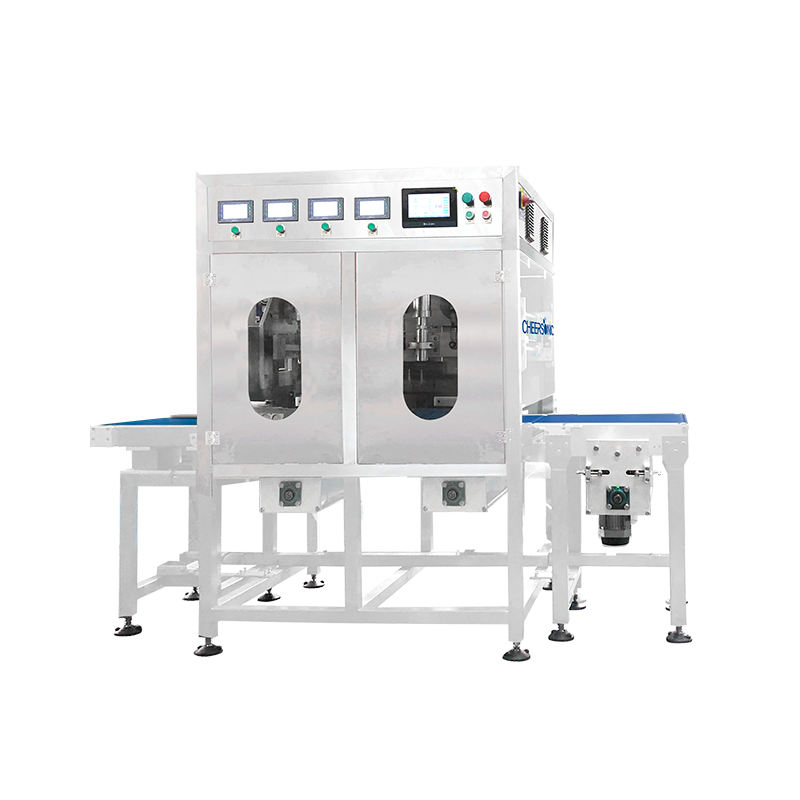
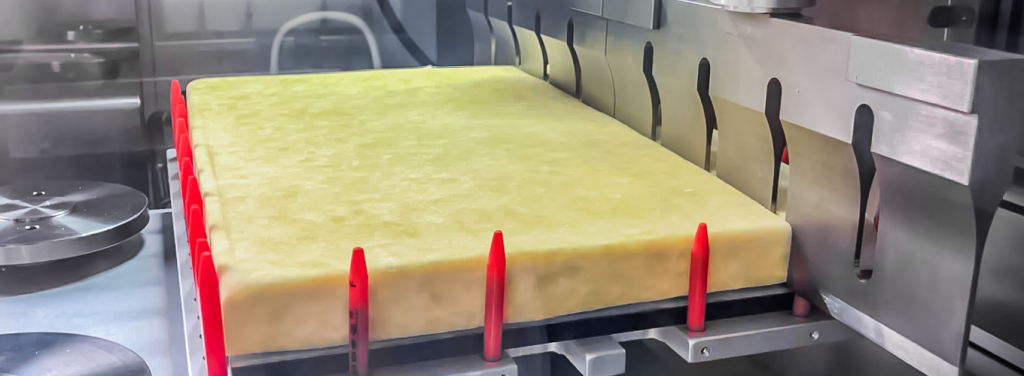
Improved Cutting Accuracy: If the cheese block needs to be further cut into smaller sizes, use high-precision cutting equipment, such as ultrasonic or CNC cutting equipment. These devices can accurately cut according to the set dimensions, reducing weight errors during the cutting process. Before cutting, calibrate the cutting equipment to ensure blade sharpness and cutting accuracy. Furthermore, during the cutting process, regularly check the weight of the cut cheese blocks and adjust the cutting equipment parameters promptly based on the weight feedback.
Integrating ultrasonic cutting technology into a square cheese slicer with a production capacity of 200 parts per minute requires precise system design. This device usually consists of the following core modules: cheese continuous feeding system, synchronous cross cutting and longitudinal cutting unit, product separation and conveyor belt, and intelligent control system. The feeding part adopts a constant temperature and pressure extrusion method to ensure that the processed cheese enters the forming channel at a constant density and temperature, forming a regular square cross-section strip material. Subsequently, the longitudinal ultrasonic cutting blade group first divides the material strip into long strips of predetermined width, and then the transverse ultrasonic cutting blade completes the fixed length cutting with high-frequency action, forming independent square cheese blocks. The synchronous coordination of the two cutting steps is the key to ensuring a production capacity of 200 parts per minute – each cutting cycle needs to be completed within 0.3 seconds, and the cutting accuracy tolerance should be controlled within ± 0.5 millimeters.
3. Post-Production Quality Inspection and Adjustment
Weight Inspection System: Establish a comprehensive weight inspection system to weigh each cheese block before packaging. High-precision electronic scales or conveyor belts with weight detection capabilities can be used. For example, the scale can be set to an accuracy of 0.1 grams. As the cheese block passes through the scale, the weight data is automatically recorded and compared with the set standard weight. Cheese blocks that do not meet the weight standard are separated for further processing, such as reprocessing or adjustment.
Data Analysis and Feedback Adjustment: Collect and analyze the weight inspection data. Use statistical analysis methods, such as calculating the average and standard deviation, to understand the weight distribution of the cheese blocks. If significant deviations or increased dispersion in the weight data are found, trace back to each stage of the production process. For example, if the average weight of a batch of cheese blocks is significantly lower than the standard weight, it may indicate a problem in the raw material filling process, such as incorrect parameter settings on the filling equipment or changes in the density of the raw materials. Based on the data analysis results, make targeted adjustments to relevant stages of the production process, including equipment parameters and raw material formulas, to ensure that the weight of subsequently produced cheese blocks meets the requirements.
About Cheersonic
Cheersonic manufactures the leading portioning equipment for bakeries producing fresh and frozen desserts. Since 1998 bakers have used Cheersonic machines to cut, slice and portion cheesecake, pie, layer cake, loaves, butter, cheese, pizza, sandwichs, and more. Cheersonic offers ultrasonic cutting solutions that support start-up bakeries and high production commercial facilities alike. Small standalone machines can be used in manual baking facilities and large inline robotic solutions aid in high speed production.
Cheersonic offers many ultrasonic slicing models, both inline and offline applications, with production speeds of 80 to 1,500 cakes or pies per hour.
Cheersonic’ latest offline introductions include ultrasonic cutting with or without divider inserts between each slice. This improves the quality of the cut and makes for a much better product presentation for the customer. In addition, robotic arm improves the speed, efficiency, and accuracy of the cutting process, producing professional looking products every time.
