
Construction Plan for Mousse Cake Automatic Production Line
Construction Plan for Mousse Cake Automatic Production Line. The following will elaborate on multiple aspects such as production line process design, selection of core equipment, key technical points, and cost considerations.
Core Process Design of Production Line
A standard mousse cake production line usually includes the following processes, which can be fine tuned according to the product type (cup packaging, cutting, overall round/irregular shape):
Raw Material Preparation Area → Cake Bottom Making → Mousse Slurry Preparation → Combination Injection Molding → Freeze Forming → Demolding/Decoration → Packaging → Refrigerated Storage/Shipping
1. Raw material preparation area
- Function: Reception, temporary storage, and pre-processing of all raw materials.
- Operation: Thaw cold chain materials (cream, cheese, milk), clean and cut fruits, sieve powders, etc.
- Equipment: Workbench, sink, shelf, refrigeration/freezer.

2. Cake making section
- Process: Digesting cookies/Oreo flakes → Mixing with melted butter → Filling into the bottom of the mold and compacting.
- Equipment:
*Biscuit grinder: Quickly crush the entire pack of cookies into uniform powder.
*Blender (with paddle shaped head): used for mixing butter and cookie crumbs.
*Automatic bottom filling machine (optional, high-end automation line): Automatically fill the cake bottom material into the mold in a quantitative manner and compact it. Handmade threads are compacted using tools such as rolling pins.
3. Mousse pulp preparation section (core link)
- Process: This is the core of flavor and texture. Usually involves pasteurization (if containing raw eggs or dairy products), mixing, homogenization, whipping, etc.
- Common slurry composition:
*Cheese paste: cream cheese, sugar, sour cream, etc.
*Chocolate Ganache: Chocolate is melted and mixed with cream.
*Guorong mousse: a mixture of Guorong, sugar, gelatin solution, and whipped cream/protein.
*Whipping cream/egg whites: providing a light and airy sensation to mousse. - Equipment:
*Sandwich pot: used for heating and melting chocolate, cheese, gelatin, making Cassia sauce, etc. Mixing and temperature control functions are crucial.
*Homogenizer: Breaking down particles (such as sugar and cheese particles) in the slurry to make it extremely smooth and delicate in taste, is a key equipment for improving quality.
*Planetary mixer: used for large-scale whipping of cream, protein cream, and mixing of various pastes.
*Pasteurization machine: If the formula contains fresh ingredients such as eggs, it must go through this process to ensure food safety.
4. Combination and injection molding section
- Process: Inject the prepared various mousse slurries into the mold with the cake bottom placed in sequence. It may contain multiple layers (such as cake base mousse layer jelly layer cake slice mousse layer).
- Equipment:
*Semi automatic/fully automatic feeding machine: This is the core of automated production. It can accurately control the injection amount and sequence of each cup/mold to ensure product consistency.
*Conveyor belt: Connecting various workstations, molds are placed on the conveyor belt for circulation.
*Vibration table: After injection molding, gently vibrate to eliminate large bubbles in the slurry and make the surface smooth.
5. Freezing and shaping section
- Process: The injected mousse cake must quickly enter the Spiral Freezer for rapid freezing (IQF) to lock in shape, prevent ice crystal formation from damaging taste, and improve efficiency.
- Equipment:
*Spiral freezing tunnel: With a small footprint and high efficiency, it is a standard configuration for continuous production. The temperature is usually set between -35 ℃ and -40 ℃.
*Tray/shelf: carrying molds into the freezer.
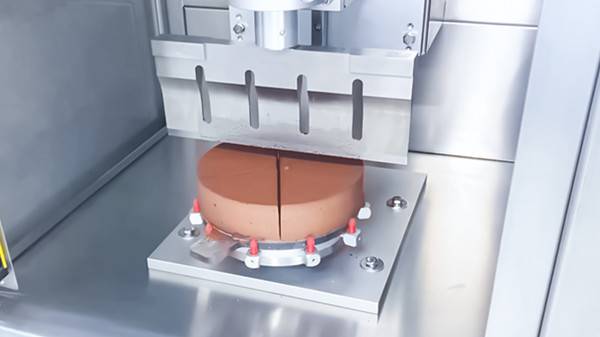
6. Demoulding and Decoration Section
- Process: The completely frozen cake is taken out of the freezer and subjected to demolding (if necessary), topping, sandblasting, fruit/chocolate accessory decoration, etc.
- Equipment:
*Demoulding machine (for silicone molds): uses air or water pressure to separate the frozen cake from the mold.
*Automatic topping machine: provides a bright and uniform layer of mirrored pectin or chocolate topping for cakes.
*Sandblasting machine: provides a velvet like texture for products such as chocolate mousse.
*Decorative workbench: an area where the final decoration is done manually.
7. Packaging and Labeling Section
- Process: The decorated cake enters the packaging stage. This may include placing an inner tray, covering, labeling, coding (production date, shelf life), and packing into an outer box.
- Equipment:
*Automatic packaging machine (such as cup cake capping machine, labeling machine).
*Heat shrink film packaging machine (for whole cakes).
*Spray coding machine.
*Automatic sealing machine.
8. Refrigerated storage
- Function: Packaged products need to be immediately transferred to a refrigerated warehouse (usually 0-4 ℃) for storage and waiting for shipment. The entire cold chain is the lifeline of Muse products.
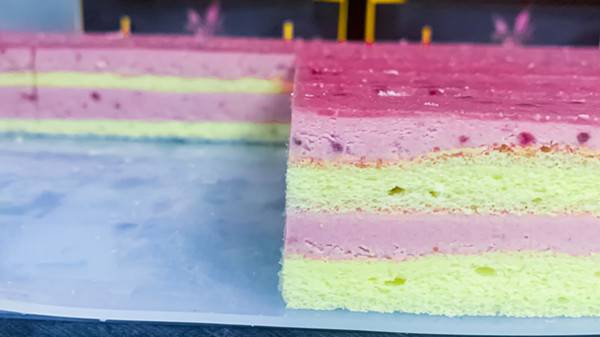
Equipment selection and production capacity considerations
Raw material processing: mixer, crusher
Slurry preparation: sandwich pot, homogenizer, planetary mixer
Injection molding: injection molding machine, conveyor belt
Freezing: Freezing Tunnel
Demoulding decoration: demoulding machine, coating machine
Packaging: capping machine, labeling machine, coding machine
Example of Capacity Calculation:
*Assuming that the freezing tunnel cycle lasts for 30 minutes.
*The tunnel can accommodate 1000 molds at a time.
*The theoretical hourly production capacity is 1000 units/0.5 hours=2000 units/hour.
*The actual production capacity needs to consider equipment switching, cleaning, and failure time, usually calculated at 85% efficiency: 2000 * 0.85=1700 units/hour.
Key Technologies and Quality Control Points
1. Formula standardization: Industrial production formulas must be precise to grams and undergo rigorous testing to ensure consistent stability during mass production.
2. Food Safety and HACCP:
*Pasteurization: Sterilization treatment of raw materials containing eggs and milk.
*Cold chain control: Temperature monitoring throughout the entire process from raw materials to finished products (2-4 ℃) to prevent microbial growth.
*Cleaning and Disinfection (CIP/SIP): Large equipment is best equipped with CIP function, which can automatically clean and disinfect pipelines, cylinder bodies, etc. to ensure hygiene.
3. Taste and texture:
*Homogenization: Ensure that the slurry is particle free and has a smooth texture.
*Rapid freezing: small ice crystals, with a more delicate taste.
*Use of stabilizers: Moderate use of stabilizers such as gelatin and pectin can extend shelf life and maintain shape stability.
4. Shelf life: Under 4 ℃ refrigeration conditions, the shelf life of commercially produced mousse cakes usually ranges from 7-45 days, depending on the formula, production process, and packaging technology (such as modified atmosphere packaging MAP).
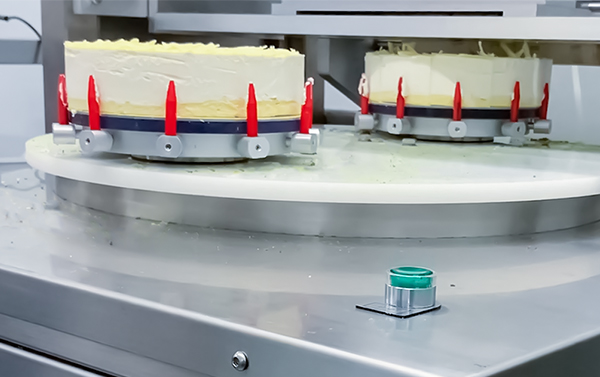
Investment and Cost Analysis
1. Initial investment:
*Semi automatic line (core equipment+a large amount of manual labor): approximately 500000 to 1.5 million RMB.
*Fully automated line (highly automated, with minimal manual labor): Approximately 2-5 million RMB, or even higher.
*The main costs are: spiral freezing tunnel, fully automatic feeding machine, homogenizer, and sandwich pot.
2. Operating costs:
*Raw material costs: High quality chocolate, cheese, cream, etc. account for the majority.
*Labor cost: The higher the degree of automation, the lower the labor cost.
*Energy consumption cost: Large refrigeration equipment and refrigeration units are major consumers of electricity.
*Packaging material cost.
Summary and Suggestions
1. Start small: If it is not a large food factory, it is recommended to start with semi automation. Invest in key sandwich pots, homogenizers, planetary mixers, and spiral freezing tunnels, and use manual or semi-automatic equipment for injection molding and packaging to reduce initial investment risks.
2. Emphasize research and development: Industrial formulas are completely different from household formulas and require food engineers or experienced professionals to debug and test stability.
3. Focus on the cold chain: ‘Without the cold chain, there would be no mousse’. Cold chain is the highest priority consideration in the entire factory design and logistics planning.
4. Consult professional manufacturers: During the planning stage, it is best to consult multiple food machinery equipment manufacturers who can provide complete solutions that better fit your product characteristics and budget.
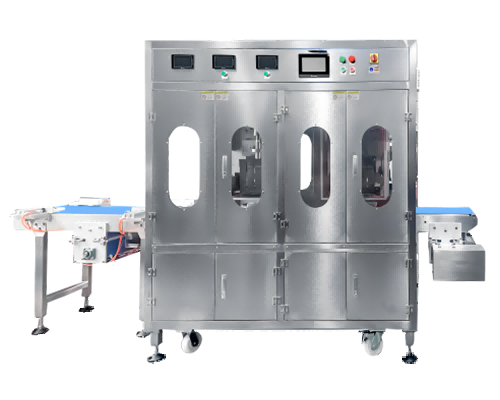
About Cheersonic
Cheersonic manufactures the leading portioning equipment for bakeries producing fresh and frozen desserts. Since 1998 bakers have used Cheersonic machines to cut, slice and portion cheesecake, pie, layer cake, loaves, butter, cheese, pizza, sandwichs, and more. Cheersonic offers ultrasonic cutting solutions that support start-up bakeries and high production commercial facilities alike. Small standalone machines can be used in manual baking facilities and large inline robotic solutions aid in high speed production.
Cheersonic offers many ultrasonic slicing models, both inline and offline applications, with production speeds of 80 to 1,500 cakes or pies per hour.
Cheersonic’ latest offline introductions include ultrasonic cutting with or without divider inserts between each slice. This improves the quality of the cut and makes for a much better product presentation for the customer. In addition, robotic arm improves the speed, efficiency, and accuracy of the cutting process, producing professional looking products every time.
Chinese Website: Cheersonic Provides Professional Ultrasonic Cutting Solutions