
Global and Chinese Mousse Cake Market Research (2023-2025): Growth Drivers and Future Breaking Directions
Market size and growth trend
Worldwide, consumers’ demand for exquisite desserts continues to rise, with one of the core driving forces being the “beauty economy” generated by social media – desserts with exquisite appearances are more likely to trigger dissemination and sharing; At the same time, the demand for health has become an important trend, and mousse cakes made with low sugar formulas and plant-based ingredients are gradually occupying market share.
According to the scale forecast, the global mousse cake market is expected to reach 12-15 billion US dollars by 2025, with a compound annual growth rate (CAGR) of 6% -8% during the period of 2023-2025.
The growth of the Chinese market is even more rapid, driven by core factors such as the expansion of consumer scenarios through the launch of co branded mousse cakes by leading new tea beverage brands, and the promotion of high-end product upgrades by chain baking brands. It is expected that the size of China’s mousse cake market will exceed 8 billion yuan by 2025, with a CAGR of over 10% during the same period, significantly higher than the global average.
Consumer Trends and Product Innovation Directions
1. Health upgrade
Low sugar/sugar free direction: Erythritol, Arhat fructose and other natural sugar substitutes are widely used in the industry to replace traditional sucrose, which can reduce calories while preserving sweetness;
Clean label trend: products are often labeled with “no artificial essence, no hydrogenated cream”, and natural formula represented by “pure animal cream mousse” is more popular;
Functional innovation: adding collagen (focusing on beauty concepts), probiotics (focusing on intestinal health) and other ingredients to accurately match the needs of segmented populations.
2. Breakthrough in flavor and form
Shape adaptation scenario: 3D printing technology is used to customize birthday cakes, and mini mousse cups have become a popular category in convenience stores due to their convenience;
Dual track development of flavor: exploring tea flavors such as Longjing and Pu’er in the localization direction, and introducing classic flavors such as Japanese matcha and Italian tiramisu in the internationalization direction;
Integration of regional characteristics: Develop customized products with local flavors based on different regional dietary preferences.
3. Target audience segmentation
Generation Z: Emphasize social attributes and prefer co branded products that collaborate with anime and trendy IPs;
Urban white-collar workers: Driven by the afternoon tea scene, the sales of single serving mousse have increased due to its low burden and easy sharing;
Children’s market: Focusing on “nutrition+fun”, the product adopts cartoon shapes and strengthens the addition of nutrients such as calcium and vitamins.
Channel layout and marketing strategy
1. Offline channels: Balancing scenarization and convenience
High end baking stores: With a focus on scene based experiences, create a refined consumer atmosphere through store design and product display;
Convenience store channel: With the advantage of high-frequency reach, promote the market popularization of mini mousse cups and ready to eat products.
2. Online channels: Function segmentation and experience upgrade
Comprehensive e-commerce platform: providing customized birthday cake services, supporting personalized design (such as styling and text customization);
Live streaming sales scenario: By showcasing the process of making mousse cakes, highlighting core selling points such as “air feel” and “delicate taste”, it stimulates instant ordering.
3. Marketing innovation direction
Content seeding: On social media platforms, “popular mousse” reviews, sharing of consumption scenarios, and other content have become hot traffic topics, driving product awareness to increase;
Cross border linkage: Cooperate with coffee brands to launch “coffee+mousse” matching packages, or collaborate with high-end food brands to create limited edition products, enhancing brand premium.
Market competition pattern
International brands: often enter the market through category extension or regional characteristics, such as mousse cakes based on ice cream and mousse products that focus on Japanese delicate taste, relying on brand awareness to occupy a portion of the high-end market share;
Local mature brands: forming advantages in high-end customization (such as personalized birthday cakes) and online popular product creation, accumulating customer base through stable quality;
New and emerging brands: breaking through with segmented tracks, focusing on health concepts (emphasizing low sugar and functional formulas), and deeply cultivating Chinese style aesthetics (integrating traditional elements into styling design), quickly attracting specific consumer groups.
Core challenges and risks
Homogenization competition intensifies: Some internet celebrity mousse products lack technological barriers and have a short lifecycle, which can lead to a rapid decline in popularity;
Cold chain logistics constraints: Mousse cakes require low-temperature storage and transportation throughout the entire process, resulting in high costs and difficulties in cross regional distribution, which limits the speed of market expansion;
Consumer cognitive bias: Some potential customer groups believe that mousse is “too sweet” due to traditional perceptions, and their acceptance of the product needs to be improved through market education.
Future development opportunities
Potential for sinking markets: With the upgrading of consumption in third – and fourth tier cities, there is an increasing demand for cost-effective Muse products with affordable pricing and reliable quality;
Technological empowerment upgrade: Automated production lines reduce labor costs, cold chain technology innovation (such as some enterprises piloting drone delivery) optimizes delivery experience, and expands service radius;
Export market opportunity: The demand for Chinese style mousse (such as tea flavored and Chinese pastry fusion) in Southeast Asian Chinese gathering areas continues to grow, providing direction for local brands to go global.
Key conclusions
Product direction: Health oriented (low sugar, natural ingredients), personalized (customized design), and convenient (small serving, instant consumption) will become the core trend in the long run;
Channel strategy: The integration of online and offline is an inevitable direction, and it is necessary to focus on strengthening the “instant gratification” scenario (such as convenience store+takeaway combination) to shorten the consumption chain;
Brand breakthrough: Deepen user emotional connection through IP co branding, while relying on technological innovation (formula research and development, production process upgrading) to establish differentiated barriers and avoid homogeneous competition.
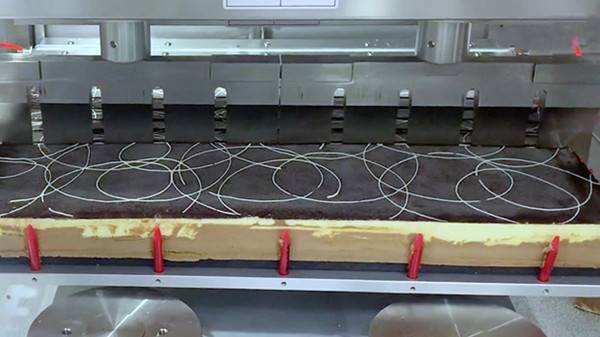
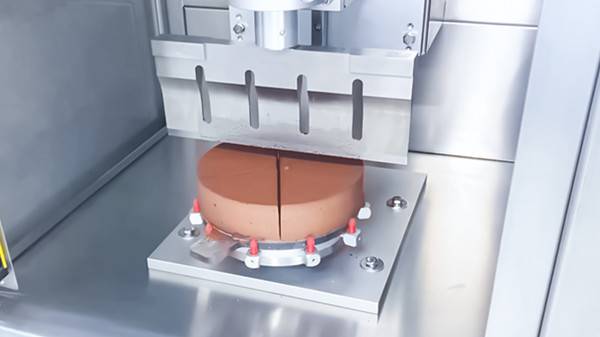
Ultrasonic cutting is a technology that uses a high-frequency vibration (usually 20-40kHz) blade to achieve cutting, especially suitable for soft and deformable ingredients such as mousse cakes.
Compared to traditional cutting tools, it solves the core pain point of mousse cutting. The high-frequency vibration of the blade causes the cutting surface to instantly separate, avoiding the cake from collapsing due to compression. The cutting edge is smooth and even, with no cream overflow or debris. At the same time, the trace heat generated by vibration can melt surface grease, forming a “self-lubricating” effect, preventing the blade from sticking to cream or chocolate layers, and eliminating the need for frequent cleaning of the blade surface.
During the cutting process, the contact time between the blade and the cake is extremely short, which will not damage the fluffy structure and layering inside the mousse, and can accurately maintain the integrity of each cake shape. At present, this technology has been widely applied in bakeries and food factories, greatly improving the cutting efficiency and finished product aesthetics of mousse cakes.
About Cheersonic
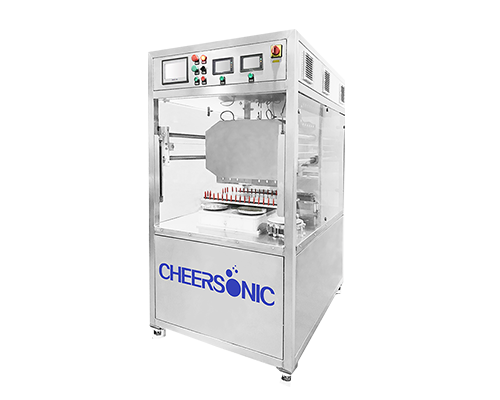
Cheersonic manufactures the leading portioning equipment for bakeries producing fresh and frozen desserts. Since 1998 bakers have used Cheersonic machines to cut, slice and portion cheesecake, pie, layer cake, loaves, butter, cheese, pizza, sandwichs, and more. Cheersonic offers ultrasonic cutting solutions that support start-up bakeries and high production commercial facilities alike. Small standalone machines can be used in manual baking facilities and large inline robotic solutions aid in high speed production.
Cheersonic offers many ultrasonic slicing models, both inline and offline applications, with production speeds of 80 to 1,500 cakes or pies per hour.
Cheersonic’ latest offline introductions include ultrasonic cutting with or without divider inserts between each slice. This improves the quality of the cut and makes for a much better product presentation for the customer. In addition, robotic arm improves the speed, efficiency, and accuracy of the cutting process, producing professional looking products every time.
Chinese Website: Cheersonic Provides Professional Ultrasonic Cutting Solutions