
Semi-automatic Ultrasonic Cutting Machine of Soap Blocks
Semi-automatic ultrasonic cutting machine achieves precise slitting of 400×400×25mm soap blocks
In the standardized production process of daily chemical products, the slitting of soap blocks directly affects the finished product’s shape and market competitiveness. Traditional cutting methods often face problems such as blade sticking, rough edges, and dimensional deviations. However, the semi-automatic ultrasonic cutting machine, with its high-frequency vibration technology, provides an efficient and precise solution for slitting a 400×400×25mm soap block into 25 standard 80×80mm pieces, making it particularly suitable for the large-scale production needs of small and medium-sized daily chemical enterprises.
I. Cutting Requirements and Core Challenges Analysis
The core parameters for this cutting task are: raw material size 400×400×25mm, target finished product 25 80×80mm pieces, with each piece’s size precisely matching mainstream market specifications, and the thickness remaining constant at 25mm. From a technological perspective, there are three main challenges: First, soap has a certain degree of stickiness, and traditional blade cutting easily leads to adhesion, resulting in edge damage and increased debris. Second, the 25mm thickness is relatively thin, and uneven pressure during cutting can easily cause material deformation, affecting dimensional accuracy. Third, the 25 finished products need to be evenly cut, requiring the cutting path to precisely correspond to a 5×5 grid layout, with cumulative errors controlled to a very small range to ensure overall uniformity.
II. Working Principle of the Semi-Automatic Ultrasonic Cutting Machine
The core of this equipment consists of an ultrasonic generator, transducer, amplitude transformer, and titanium alloy cutting head. It achieves precise cutting through “electromechanical energy conversion.” During operation, the ultrasonic generator converts mains power into a 20-40kHz high-frequency electrical signal. The transducer uses the piezoelectric effect to convert this signal into high-frequency mechanical vibration, which is then amplified to 10-40μm by the amplitude transformer before being transmitted to the cutting head.
When the high-speed vibrating cutting head contacts the soap block, it does not perform traditional “compression cutting,” but rather uses microscopic vibration to instantly break down the molecular chains on the cutting surface, achieving a “micro-vibration separation” effect. This non-contact cutting method can reduce the coefficient of friction by more than 90%, fundamentally solving the problem of sticking to the blade, while avoiding material deformation due to heat, making it a perfect fit for the properties of soap.
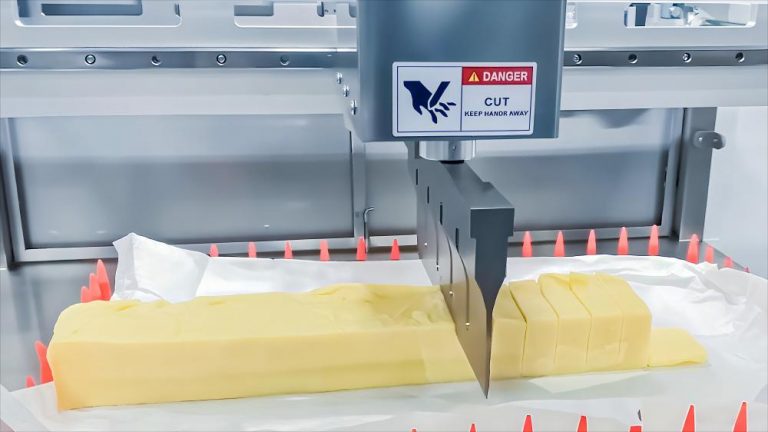
III. Precise Cutting Implementation Steps
Preliminary Preparation
1. Equipment Debugging: Based on the characteristics of the soap material, adjust the equipment frequency to 30kHz, power to 250-300W, and amplitude to 20-25μm to ensure cutting force while avoiding material damage. The blade is made of food-grade titanium alloy to ensure hygienic and safe cutting. Simultaneously, calibrate the blade’s perpendicularity beforehand, controlling the error within 0.1mm.
2. Raw Material Pretreatment: Place the soap block at room temperature (15-20℃) for 2 hours to ensure uniform material hardness and prevent adhesion due to excessive heat or breakage due to excessive cold. If the soap contains essential oils, it can be refrigerated to 5℃ beforehand to further reduce surface stickiness.
3. Positioning Layout: Mark a 5×5 grid on the cutting platform, with each grid spaced 80mm apart. Secure the soap block with positioning clamps to ensure precise cutting position and avoid misalignment.
Slitting Operation
1. Equipment Start-up: After the ultrasonic cutter head stabilizes and vibrates, slowly lower the cutter head to the surface of the soap block and cut longitudinally at a uniform speed of 5mm/s. After completing the first longitudinal cut, complete the remaining four longitudinal cuts in sequence.
2. Transverse Slitting: Keeping the equipment parameters unchanged, complete five transverse cutting lines, ultimately dividing the 400×400mm raw material evenly into 25 80×80mm finished products. Observe the cutter head’s operating status in real time during the cutting process. If slight adhesion occurs, the feed speed can be appropriately reduced to 3mm/s.
3. Finished Product Collection: After cutting, promptly clean up the debris on the platform and neatly arrange the finished products to avoid stacking and deformation caused by compression.
IV. Process Advantages and Quality Assurance
Core Advantages
1. High Cutting Precision: The cutter head vibration achieves pressureless cutting, precise positioning, and the finished product size error is controlled within ±0.2mm, with a cut surface perpendicularity error of less than 0.1mm, fully meeting standardized production requirements. 2. Superior Appearance Quality: Vibration cutting avoids issues such as rough edges, stringing, and debris, resulting in a smooth and flat cut surface without melted edges or scorch marks, preserving the original texture of the soap and enhancing the product’s visual appeal.
3. High Production Efficiency: Semi-automatic equipment can complete all cutting in a single pass, increasing efficiency by 3-5 times compared to manual cutting. It can process 50-80 raw materials per hour, suitable for small to medium batch production needs.
4. Significant Cost-Effectiveness: The titanium alloy cutter head has a long service life, with maintenance costs only 1/5 of traditional cutters. The cutting process produces no dust or wastewater, meeting environmental production standards.
Key Points of Quality Control
1. Parameter Calibration: Calibrate the equipment frequency and power before daily production to ensure parameter stability and avoid differences in cutting results due to parameter fluctuations.
2. Raw Material Control: Strictly control the hardness and temperature of the soap blocks to ensure uniform material composition. Small-batch trial cutting is required for different batches of raw materials in advance. 3. Equipment maintenance: Regularly clean the cutter head and transmission components, check the wear of the cutter head, and replace severely worn cutter heads in a timely manner to ensure cutting accuracy.
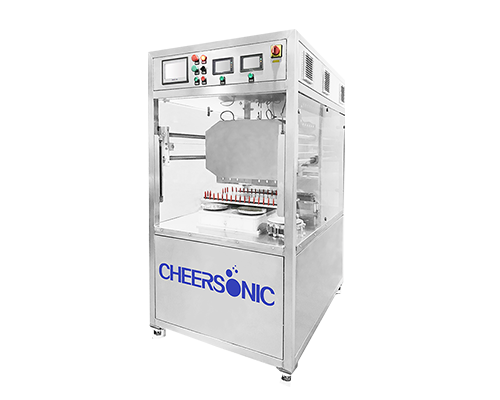
V. Application Value and Industry Adaptability
The application of semi-automatic ultrasonic cutting machines in soap slitting not only solves the pain points of traditional processes but also promotes the standardization and upgrading of daily chemical product manufacturing. Its adaptability is wide; in addition to ordinary laundry soap and transparent soap, it can also cut modified soaps and essential oil soaps with different hardness by adjusting parameters, meeting diverse product needs. At the same time, the equipment is easy to operate, requiring no specialized technicians to master, and is suitable for various scenarios such as handmade soap workshops and small and medium-sized daily chemical factories, providing reliable support for product quality improvement and production efficiency optimization.
Against the backdrop of consumption upgrading, consumers’ requirements for the appearance and quality of soap products are constantly increasing. Semi-automatic ultrasonic cutting machines, with their precise and efficient cutting effects, help enterprises create standardized, high-quality products and enhance market competitiveness. With technological iteration, this equipment will further achieve automated integration, promoting the intelligent development of the entire soap production process and injecting new impetus into the high-quality development of the daily chemical industry.
About Cheersonic
Cheersonic manufactures the leading portioning equipment for bakeries producing fresh and frozen desserts. Since 1998 bakers have used Cheersonic machines to cut, slice and portion cheesecake, pie, layer cake, loaves, butter, cheese, pizza, sandwichs, and more. Cheersonic offers ultrasonic cutting solutions that support start-up bakeries and high production commercial facilities alike. Small standalone machines can be used in manual baking facilities and large inline robotic solutions aid in high speed production.
Cheersonic offers many ultrasonic slicing models, both inline and offline applications, with production speeds of 80 to 1,500 cakes or pies per hour.
Cheersonic’ latest offline introductions include ultrasonic cutting with or without divider inserts between each slice. This improves the quality of the cut and makes for a much better product presentation for the customer. In addition, robotic arm improves the speed, efficiency, and accuracy of the cutting process, producing professional looking products every time.