
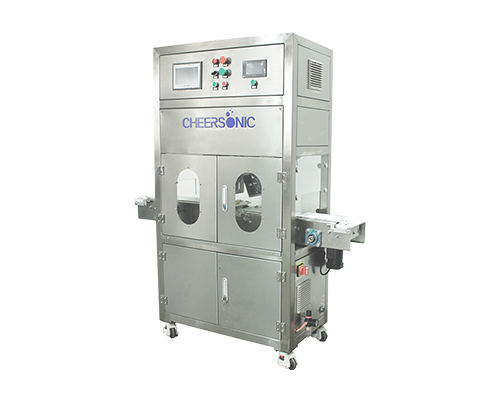
Ultrasonic Cutting Machine for Cutting Pet Sausages
Ultrasonic cutting machines have shown significant technical adaptability in the processing of pet sausages, especially for the characteristics of “soft, elastic, and containing particles/colloids” in pet sausages, which can effectively solve the pain points of traditional cutting. The following analysis focuses on adaptability, core advantages, operational points, and application value:
Adaptation of Ultrasonic Cutting Principle to the Characteristics of Pet Sausage
Ultrasonic cutting achieves material “vibration separation” through high-frequency vibration (20-40kHz) blades, rather than the “extrusion fracture” of traditional cutting. This characteristic highly matches the physical properties of pet sausages:
Pet ham sausages are usually made from meat (such as chicken, beef, etc.), with added starch, colloids (such as carrageenan), oils, and nutritional additives. After emulsification, enema, and steaming, they form products with soft and elastic texture, uniform structure (or containing a small amount of meat particles), and high moisture/oil content. Traditional cutting methods, such as knife cutting and wire cutting, are prone to deformation (such as cross-sectional collapse), edge adhesion, and filling extrusion (especially for high-fat/high moisture products) due to compression. However, the “low-pressure vibration separation” mode of ultrasonic cutting can minimize damage to the structure of the sausage and adapt to its soft elastic properties.

The core advantages of ultrasonic cutting in pet sausages
1. The cutting surface should be flat to avoid extrusion and deformation of the filling
Pet sausages contain colloids and oils, and their structure has “elastic recovery”. Traditional knife cutting can cause temporary deformation of the cutting area due to blade compression, resulting in edge collapse or filling extrusion from the incision after loosening (especially for thicker diameter sausages); The high-frequency vibration of ultrasonic blades can instantly separate tissues, and the cutting force is concentrated at the blade contact point, exerting minimal pressure on surrounding tissues. After cutting, the cross-section is smooth and rounded, without collapse or overflow of filling, significantly improving the appearance regularity of the product (such as the consistency of the length and smoothness of the cross-section of segmented ham sausages).
2. Reduce sticking knives and lower cleaning costs
The oil and colloids (such as carrageenan) in pet sausages are prone to adhere to traditional blades, resulting in residual filling after cutting. Frequent shutdown and cleaning are necessary to avoid contaminating subsequent products. The high-frequency vibration of ultrasonic blades produces a “micro bounce” effect, reducing the contact time between the filling and the blade. At the same time, the vibration can shake off a small amount of residual material, greatly reducing the probability of sticking to the blade. Experimental data shows that compared to traditional knife cutting, the sticking frequency of ultrasonic cutting can be reduced by more than 60%, reducing downtime for cleaning and improving production continuity.
3. Compatible with ham sausages containing particles/composite structures for more stable cutting
Some pet sausages add minced meat particles (such as chicken breast and beef) to enhance their taste. Traditional cutting methods often cause the blade to jam or deviate due to particle obstruction, resulting in rough edges and uneven length; The high-frequency vibration of ultrasonic blades can quickly “break” the connection between particles and matrix, even when cutting ham sausages containing 1-3mm particles, it can maintain a smooth cutting surface without particle detachment or edge tearing.
4. Precise fixed length cutting, adapted to diverse specification requirements
Pet sausages often need to be processed into different lengths (such as 5cm short segments, 10cm long segments) or irregular shapes (such as oblique cuts, stepped shapes). Traditional cutting relies on manual or mechanical positioning, with large errors (± 1-2mm); The ultrasonic cutting machine can control the feeding speed and blade synchronization through a servo motor, and cooperate with a photoelectric sensor to achieve precise cutting of fixed length. The error can be controlled within ± 0.5mm, meeting the packaging needs of “small size, high precision” pet food (such as quantitative control of single independent packaging).

5. Low temperature cutting to preserve nutrition and flavor
The nutritional components of pet sausages, such as protein and fat soluble vitamins, are sensitive to high temperatures. The friction heat generated by traditional cutting or the high temperature generated by laser cutting can easily lead to local oil oxidation and colloid denaturation, affecting flavor (such as producing a halal flavor) or nutritional stability. Ultrasonic cutting is mainly based on mechanical energy vibration, and the temperature rise in the cutting area is usually ≤ 3 ℃, which can avoid the damage of high temperature to the nutrition and flavor of ham sausage, and maintain its original soft and elastic taste and palatability.
Key points of operation and optimization suggestions
1. Raw material pretreatment: control hardness and temperature
The softness and hardness of pet sausages directly affect the cutting effect:
Newly cooked hot leg sausages (60-70 ℃) have a soft texture, strong stickiness, and are prone to sticking to knives; It is recommended to cool down to room temperature (20-25 ℃) or refrigerate (4-10 ℃) before cutting, and use low temperature to increase material hardness, reduce deformation and knife sticking.
Ham sausages containing a high proportion of colloids (such as high elasticity) can be refrigerated at a lower temperature (4-6 ℃) to avoid collapse of the cutting surface due to excessive softness.
2. Equipment parameter debugging: matching frequency, speed, and pressure
Vibration frequency: It is recommended to use 20-25kHz for soft low particle ham sausages, and 25-30kHz for ham sausages containing particles or high hardness (high starch) to ensure that the vibration energy is sufficient to separate particles from the matrix.
– Cutting speed: For sausages with a diameter ≤ 20mm, it is recommended to use a speed of 3-5m/min, and for sausages with a diameter of 20-30mm, it is recommended to use a speed of 2-3m/min. If the speed is too fast, it can lead to incomplete cutting (resulting in “wire drawing” residue).
Blade pressure: Based on the principle of “cutting with a light touch”, excessive pressure will increase extrusion deformation, usually set at 0.05-0.2MPa (specific adjustments need to be made through trial cutting, subject to no collapse of the cutting surface).

3. Blade selection and anti sticking design
The blade material is made of food grade titanium alloy, and the cutting edge needs to undergo “anti sticking treatment” (such as nano coating) to reduce oil/gel adhesion; The recommended blade angle is 15 ° -30 ° (sharp angles are more suitable for soft materials).
– For irregular cutting needs (such as inclined and rounded sections), corresponding shaped blades can be customized, and the angle adjustment function of the equipment can be used to achieve diversified cutting.
4. Hygiene control and maintenance: Adapt to pet food standards
The equipment needs to adopt a “fully enclosed waterproof structure”, and the cutting area should be isolated from components such as vibration generators and motors to prevent meat residue and oil from seeping into the interior of the equipment; The contact parts such as blades and feeding conveyor belts should be quickly detachable, cleaned daily with food grade neutral cleaning agents, and disinfected at high temperatures (washed with hot water above 85 ℃) every week.
Regularly check blade wear (whether the blade edge is passivated) and vibration system stability (such as whether the amplitude is uniform), and polish worn blades in a timely manner to ensure cutting accuracy.
Summarize
The ultrasonic cutting machine perfectly solves the core problems of deformation, knife sticking, and filling extrusion in pet sausage cutting through its “low pressure, high-frequency vibration” characteristics, and has significant advantages in improving product appearance regularity, production continuity, and hygiene safety. For pet food enterprises that pursue standardized and large-scale production, it is particularly suitable for processing soft, granular or high value-added pet sausage products, which is an ideal choice for cost reduction, efficiency improvement and quality upgrading.
About Cheersonic
Cheersonic manufactures the leading portioning equipment for bakeries producing fresh and frozen desserts. Since 1998 bakers have used Cheersonic machines to cut, slice and portion cheesecake, pie, layer cake, loaves, butter, cheese, pizza, sandwichs, and more. Cheersonic offers ultrasonic cutting solutions that support start-up bakeries and high production commercial facilities alike. Small standalone machines can be used in manual baking facilities and large inline robotic solutions aid in high speed production.
Cheersonic offers many ultrasonic slicing models, both inline and offline applications, with production speeds of 80 to 1,500 cakes or pies per hour.
Cheersonic’ latest offline introductions include ultrasonic cutting with or without divider inserts between each slice. This improves the quality of the cut and makes for a much better product presentation for the customer. In addition, robotic arm improves the speed, efficiency, and accuracy of the cutting process, producing professional looking products every time.
Chinese Website: Cheersonic Provides Professional Ultrasonic Cutting Solutions