
Ultrasonic Cutting of Fresh Milk Cheese
Ultrasonic Cutting of Fresh Milk Cheese – Cheersonic
Working Principle
Generation and Transmission of Ultrasonic Waves: The ultrasonic cutting equipment contains an ultrasonic generator that converts ordinary electrical energy into high-frequency electrical energy. This high-frequency electrical energy is then transmitted to a transducer, which converts the electrical energy into mechanical vibration, i.e., ultrasonic vibration. This vibration is transmitted to the cutting edge through a special amplitude transformer or blade.
Cutting Effect in Fresh Milk Cheese: When the ultrasonically vibrating cutting edge comes into contact with the fresh milk cheese, the vibration breaks down the intermolecular bonds within the cheese. From a microscopic perspective, it’s as if countless tiny “cracks” are created inside the cheese. These cracks gradually expand under the continuous action of the vibration, ultimately allowing the cheese to be cut cleanly, rather than relying on the pressure of a blade to forcibly cut it as in traditional cutting methods.
Equipment Components
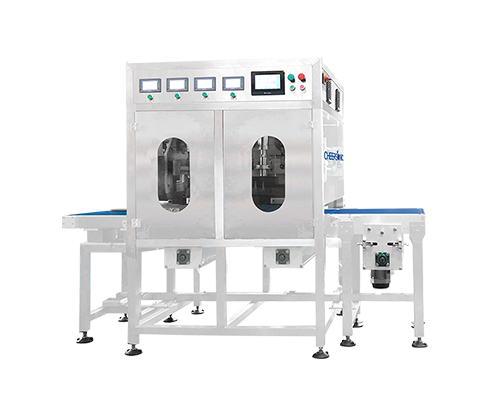
Ultrasonic Generator: This is the power source of the entire equipment, responsible for generating high-frequency electrical signals. Its output frequency is typically between 20kHz and 100kHz. This frequency range can be adjusted according to the specific characteristics of fresh cheese (such as hardness and moisture content) to achieve optimal cutting results.
Transducer and Amplitude Variable: The transducer converts the electrical energy generated by the ultrasonic generator into mechanical vibration, while the amplitude variable is used to adjust the amplitude of the vibration. Their function is to transmit ultrasonic waves of appropriate frequency and amplitude to the cutting blade, ensuring that the blade vibrates correctly for efficient cutting.
Cutting Blade: The blade is generally made of high-quality materials such as titanium alloy. Titanium alloy has high strength, good corrosion resistance, and excellent acoustic properties, effectively transmitting ultrasonic vibrations and maintaining sharpness and durability during cutting. The shape and design of the blade are determined according to cutting requirements; for example, for slicing, a square or rectangular blade may be used; for slicing, a longer and thinner blade will be used.
Control System: Parameters such as cutting speed, cutting size, ultrasonic frequency, and amplitude can be set. Through precise control, it can adapt to the cutting requirements of different types and states of fresh cheese. For example, for softer cheeses, the cutting speed can be reduced and the ultrasonic frequency adjusted appropriately to prevent excessive deformation.
Application Scenarios and Precautions
Application Scenarios:
Food Processing Plants: In large-scale production of fresh milk cheese products, ultrasonic cutting equipment can precisely cut cheese into slices and cubes of various sizes for packaging and sales. For example, cheese can be cut into thin slices suitable for sandwiches or small cubes suitable for snack packaging.
Catering Industry: Used in restaurant and hotel kitchens for the pre-processing of cheese ingredients. Cheese can be cut quickly and accurately according to the requirements of the dishes, such as for making salads, pasta, or cheese-baked rice.
Precautions:
Equipment Parameter Adjustment: Different brands and batches of fresh milk cheese may vary in hardness, moisture content, etc., requiring adjustment of the ultrasonic cutting equipment parameters according to the actual situation. For example, freshly made cheese may be relatively soft, requiring a reduction in cutting speed and ultrasonic vibration amplitude; refrigerated cheese may harden, in which case the vibration amplitude can be appropriately increased.
Equipment Maintenance: Although ultrasonic cutting equipment is relatively stable, it still requires regular maintenance. The working condition of key components such as the ultrasonic generator and transducer should be checked to ensure they are performing well. At the same time, care should be taken to keep the blades sharp and to clean the equipment regularly to prevent cheese residue buildup from affecting its normal operation.
About Cheersonic
Cheersonic manufactures the leading portioning equipment for bakeries producing fresh and frozen desserts. Since 1998 bakers have used Cheersonic machines to cut, slice and portion cheesecake, pie, layer cake, loaves, butter, cheese, pizza, sandwichs, and more. Cheersonic offers ultrasonic cutting solutions that support start-up bakeries and high production commercial facilities alike. Small standalone machines can be used in manual baking facilities and large inline robotic solutions aid in high speed production.
Cheersonic offers many ultrasonic slicing models, both inline and offline applications, with production speeds of 80 to 1,500 cakes or pies per hour.
Cheersonic’ latest offline introductions include ultrasonic cutting with or without divider inserts between each slice. This improves the quality of the cut and makes for a much better product presentation for the customer. In addition, robotic arm improves the speed, efficiency, and accuracy of the cutting process, producing professional looking products every time.
Chinese Website: Cheersonic Provides Professional Ultrasonic Cutting Solutions