
Ultrasonic Cutting Technology Full-Panel Sandwiches
Application of Ultrasonic Cutting Technology in the High-Efficiency Production of Full-Panel Sandwiches
In the modern food processing industry, sandwiches, as a convenient, nutritious, and diverse food, are loved by consumers worldwide. Especially in areas such as catering delivery, convenience stores, airline catering, and large-scale event catering, the mass production of standardized, high-quality sandwiches has become a core requirement for many food companies. Among these, the full-pallet sandwich production model, due to its efficient forming and cutting processes, is gradually becoming one of the mainstream solutions for industrialized production.
The Demand for Large-Scale Production of Full-Panel Sandwiches
A full-pallet sandwich refers to a sandwich where all ingredients, including bread, sauces, vegetables, meat, and cheese, are layered on a standard-sized baking pan or tray to form a large, complete sandwich “brick.” Common tray sizes are 26 inches × 18 inches (approximately 66 cm × 46 cm). After stacking and pressing, this large sandwich is then divided into smaller portions using cutting equipment before final packaging and sale.
The advantages of this production method are: First, one-time forming allows for the simultaneous processing of large quantities of raw materials, significantly increasing output per unit time; second, the layered structure ensures a uniform distribution of ingredients within each small sandwich, avoiding filling deviations that can occur with manual production; and third, it facilitates integration into automated production lines, reducing labor costs.
For end-sales purposes, the ideal size for a single sandwich is typically around 4.5 inches square. Cutting it to this size, a 26×18-inch full-pallet sandwich can be divided into approximately 24 small squares. This requires the cutting equipment to be efficient, precise, clean, and capable of not damaging the sandwich structure.

Limitations of Traditional Cutting Methods
In the past, food factories mostly used circular rotary blades, band saws, or stamping dies to cut large sandwiches. However, these methods have significant drawbacks: ordinary metal blades easily stick to sauces, mayonnaise, or cheese during repeated cutting, resulting in dirty cut surfaces, dragging, and even pulling the filling out of the sandwich; band saw cutting produces a lot of debris, wasting raw materials and potentially contaminating the product; furthermore, mechanical pressure can flatten the soft bread dough, affecting the sandwich’s appearance and texture. More importantly, traditional cutting methods struggle to ensure that the dimensional error of each piece is within acceptable limits, especially during continuous high-speed production, where blade wear further exacerbates quality fluctuations.
Principles and Advantages of Ultrasonic Cutting Technology
Ultrasonic cutting technology provides an ideal solution to the above problems. Its core principle is to use a piezoelectric transducer to convert electrical energy into high-frequency mechanical vibrations (typically 20kHz to 40kHz), causing the blade to vibrate at a frequency of tens of thousands of times per second while moving along the cutting direction. This high-frequency vibration gives the blade unique cutting characteristics:
First, extremely low cutting resistance. The coefficient of friction between the blade and the ingredients is significantly reduced, making the cutting process feel like “melting” through the material rather than squeezing and tearing. Therefore, the bread’s soft structure is preserved intact, without deformation or collapse.
Second, a clean cut. High-frequency vibration ensures that the blade surface is virtually free of sauces, butter, or moist fillings. Each cut is clean and crisp, clearly revealing the layers, without any fillings being dragged out or smeared onto the bread’s edges. This is crucial for multi-layered sandwiches.
Third, high precision and repeatability. Ultrasonic cutting systems are typically used in conjunction with CNC positioning mechanisms, enabling longitudinal and transverse slicing with millimeter-level repeatability. Whether cutting 24 or more sandwiches, each sandwich maintains a consistent size, facilitating subsequent packaging and standardized pricing.
Fourth, reduced crumbs and waste. Because the cutting process does not involve crushing or tearing, there are virtually no bread crumbs or filling spills, resulting in a material utilization rate of over 98%. This also avoids the risk of crumbs contaminating the production line or getting mixed into the finished product packaging.
Fifth, long blade life and easy cleaning. Ultrasonic vibration itself has a self-cleaning effect, making it less likely for food residue to remain on the blades and reducing the need for frequent downtime for cleaning. The blades are made of high-strength alloy materials, resulting in a wear rate far lower than traditional metal blades.
Integrated Application in Actual Production Processes
In an actual production line, an ultrasonic cutting system for 26×18-inch full-pallet sandwiches typically operates as follows:
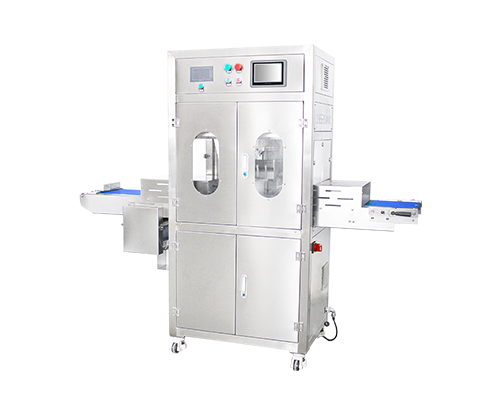
First, the stacked and pressed sandwiches are conveyed to the cutting station, where the pallet is precisely positioned. An operator or vision system confirms the bread’s edge baseline. Then, the ultrasonic cutter performs a pre-programmed horizontal cut—for example, dividing the 26-inch long side into four equal parts, each approximately 6.5 inches; followed by a vertical cut—dividing the 18-inch wide side into six equal parts, each 3 inches. Through combinations of several cuts in both directions, 24 small squares are ultimately formed, arranged in a 4×6 or similar pattern. During each cut, the blade rapidly cuts in at a vertical or slightly angled angle, the vibration instantly severing the bread, vegetables, meat slices, and cheese layers. After completion, the blade automatically lifts and moves to the next cutting line.
The entire process can be completed in seconds to tens of seconds, depending on the product thickness and equipment configuration. After cutting, a robotic arm or sorting device transfers each of the 24 small sandwiches to a packaging conveyor belt for boxing, wrapping, or sealing.
For production lines requiring higher output, dual-blade synchronous cutting or multi-station rotary table structures can be configured to match the cutting cycle with the preceding and following processes, achieving continuous, non-stop production.
Economic and Quality Enhancement
While the initial equipment investment for ultrasonic cutting technology is higher than that of traditional mechanical cutting tools, it offers significant advantages in terms of overall operating costs. First, the improved product yield typically results in raw material savings of 3% to 5% or more, which translates to considerable annual raw material cost savings for factories producing tens of thousands of sandwiches daily. Second, aesthetically pleasing and uniformly sized products can support higher retail prices or enhance brand competitiveness, especially for high-end convenience stores, hotels, and airline catering channels. Third, it reduces the risk of foreign object complaints and returns due to debris contamination, lowering quality management costs. Furthermore, ultrasonic cutting eliminates the need for frequent blade changes, reducing downtime for maintenance and improving overall equipment efficiency.
Future Development Trends
As consumers’ demands for the quality of pre-prepared foods continue to rise, and food factories upgrade towards automation and intelligence, the application scope of ultrasonic cutting technology will continue to expand. Currently, some equipment integrates online weighing, AI visual inspection, and adaptive cutting parameter adjustment functions, automatically optimizing vibration frequency and cutting speed based on the hardness and thickness differences of different batches of raw materials. For full-pallet sandwiches, future development may even enable personalized size customization—cutting different sizes of pieces simultaneously from the same pallet to meet the needs of multi-channel and multi-specification orders.
Conclusion
From 26-inch x 18-inch full pallets to exquisite 4.5-inch square portions, ultrasonic cutting technology, with its unique advantages of low resistance, high precision, and clean cut surfaces, perfectly solves the cutting challenges in the industrial production of sandwiches. It not only significantly improves production efficiency and raw material utilization but also ensures the visual appeal and taste integrity of each sandwich. For modern food companies pursuing both scale and quality, this technology has undoubtedly become a key link in the full-pallet sandwich production line, bringing consumers a consistently high-quality experience from the first bite to the last.
About Cheersonic
Cheersonic manufactures the leading portioning equipment for bakeries producing fresh and frozen desserts. Since 1998 bakers have used Cheersonic machines to cut, slice and portion cheesecake, pie, layer cake, loaves, butter, cheese, pizza, sandwichs, and more. Cheersonic offers ultrasonic cutting solutions that support start-up bakeries and high production commercial facilities alike. Small standalone machines can be used in manual baking facilities and large inline robotic solutions aid in high speed production.
Cheersonic offers many ultrasonic slicing models, both inline and offline applications, with production speeds of 80 to 1,500 cakes or pies per hour.
Cheersonic’ latest offline introductions include ultrasonic cutting with or without divider inserts between each slice. This improves the quality of the cut and makes for a much better product presentation for the customer. In addition, robotic arm improves the speed, efficiency, and accuracy of the cutting process, producing professional looking products every time.
