
Ultrasonic Pound Cake Cutting Machine
Ultrasonic Pound Cake Cutting Machine – Cheersonic Cake Cutter
In modern baking production lines, the subsequent processing stages of cakes often determine the final quality and market competitiveness of the product. Precise and efficient slicing of dense, high-sugar pound cakes has always been a technical challenge in the industry. Traditional mechanical cutting methods easily lead to broken edges, rough cuts, and even internal collapse due to excessive pressure, affecting both appearance and taste. However, with the continuous evolution of food processing technology, an advanced cutting technology based on high-frequency vibration has gradually gained widespread application. This technology converts electrical energy into mechanical energy, causing the blade to vibrate tens of thousands of times per second, achieving a “slicing” rather than “pressing” effect upon contact with the cake, significantly reducing damage to the material structure. This ultrasonic-assisted cutting method is particularly suitable for processing highly viscous and easily deformable baked goods, ensuring that each slice of cake is of uniform thickness, with a clean cut surface and virtually no crumbs. For manufacturers, this means higher yield rates, lower cleaning and maintenance costs, and more consistent product standards.
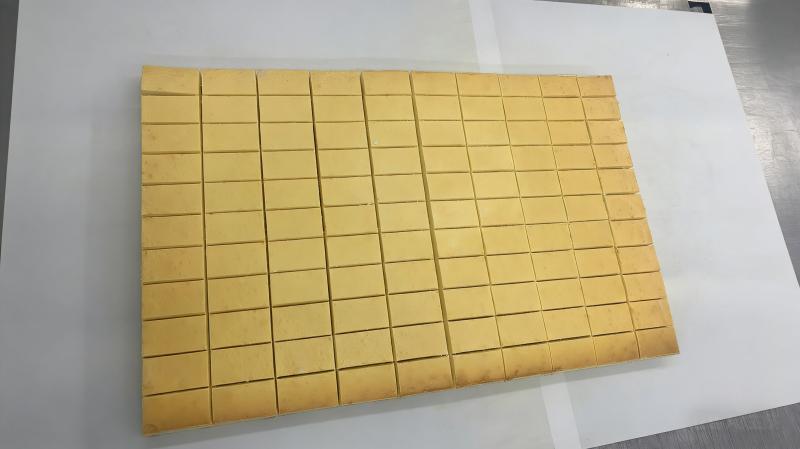
In actual production, the size of pound cakes directly affects the selection and parameter settings of slicing equipment. Taking a common, larger pound cake as an example, its length is set at 120 mm, width at 65 mm, and height at 60 mm. These three dimensions are typical in the baking industry—the 120 mm length facilitates subsequent packaging and stacking, the 65 mm width is suitable for holding and eating with one hand, and the 60 mm height ensures that the center of the cake is fully cooked after baking, while maintaining a golden-brown exterior. However, such a “solid” shape also places higher demands on the slicing process: traditional rotary slicers or bladed slicers often cause deformation on the sides of the cake due to excessive frictional heat and shearing force when slicing cakes with such thickness and density, and may even cause the internal dried fruit or nuts to shift, disrupting the originally uniform texture. Using non-contact or minimal-contact ultrasonic cutting technology, the blade vibrates at high frequency only in the vertical direction, with minimal horizontal propulsion. Therefore, even with a near-rectangular cake with a length-width-height ratio close to 1:0.54:0.5, it can easily achieve slices as thin as 5 mm or even thinner, with the dimensional error of each slice controlled within ±0.5 mm.
From a production process perspective, applying this advanced cutting solution to pound cakes of this size offers several practical benefits. First, cutting speed is significantly increased—traditional manual slicing processes a maximum of 200 to 300 cakes per hour, while automated ultrasonic equipment with a conveyor belt can increase the speed to 800 to 1200 cakes per hour, while reducing reliance on manual labor. Second, the self-cleaning effect of the blade vibration prevents syrup and grease from adhering to the blade surface, eliminating the need for frequent stops for wiping and greatly extending continuous operation time. Third, ultrasonic cutting does not produce the powdery debris of traditional sawing, preventing cake crumbs from splashing onto the conveyor belt or packaging materials, thus reducing the risk of microbial contamination and helping to extend product shelf life. For a pound cake measuring 120 mm long, 65 mm wide, and 60 mm high, ultrasonic slicing preserves the air pockets on the cut surface, leaving virtually no visible burrs or cracks. This is a crucial detail for enhancing the product image of a mid-to-high-end baking brand.
It’s worth noting that different baking workshops have varying requirements for the direction and thickness of cake slices. Some require slicing along the length (perpendicular to the 120 mm side length), while others require dividing along the width (perpendicular to the 65 mm side length). Thanks to the high flexibility of the ultrasonic cutting system, operators only need to change the cutting program via the human-machine interface, and the blade holder will automatically adjust the angle and feed path without changing any mechanical parts. For example, when slicing a 120 mm long, 65 mm wide, and 60 mm high pound cake into six evenly thick slices, the system can automatically calculate the thickness of each slice to approximately 10 mm and complete the slicing at a cycle frequency of twice per second, achieving an edge smoothness far exceeding national standards for baked goods slicing. In addition, some models are equipped with laser positioning or visual recognition modules, which can detect the actual shape of the cake in real time. If a slight deviation in size is found after baking (such as the height expanding to 62 mm), the system will automatically compensate the cutting starting point to ensure that the weight of each slice of cake is consistent. This is of great significance for subsequent quantitative packaging and cost accounting.
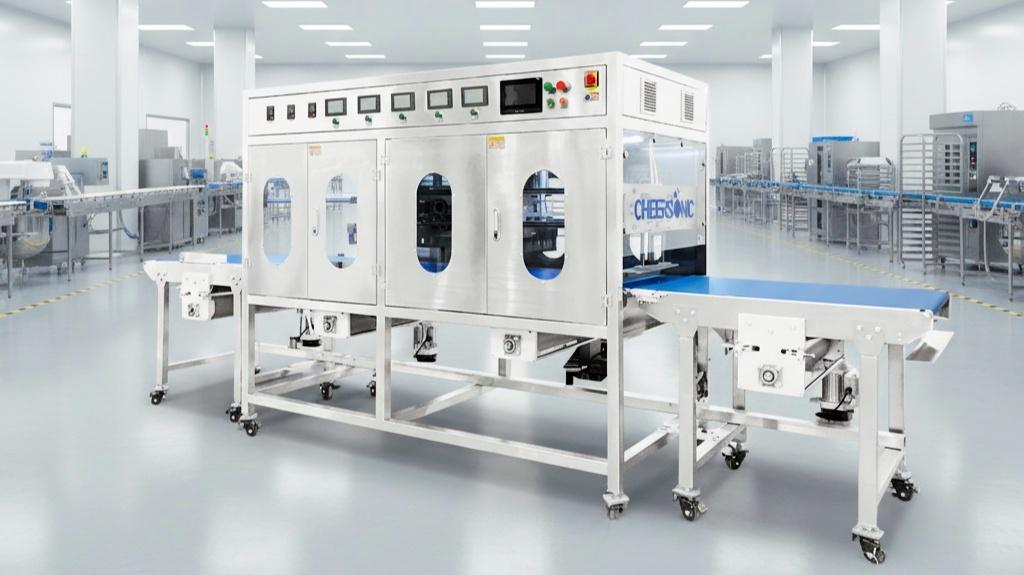
From a long-term return on investment perspective, although the initial investment in ultrasonic cutting equipment is slightly higher than that of traditional mechanical slicers, considering the reduced raw material waste (chip loss can be reduced by more than 80%), saved blade replacement costs (ultrasonic blades typically have a lifespan 5 to 10 times that of ordinary steel blades), and increased production efficiency, most medium-sized and larger baking companies can recoup the additional costs within 12 to 18 months. Especially for central factories that process tens of thousands of large pound cakes daily, this technology has transitioned from an “optional upgrade” to a “standard feature.” A pound cake measuring 120 mm long, 65 mm wide, and 60 mm high may seem ordinary, but it embodies the wisdom of multiple processes, including ingredient ratios, baking curves, and post-processing. Advanced ultrasonic cutting solutions are the “invisible blade” that unlocks its commercial value—it doesn’t pursue brute force, but only precision; it doesn’t create noise, leaving only smooth cuts and satisfied smiles. When consumers open the packaging and see neatly shaped, finely textured slices of pound cake, they may not think about the underlying technology. However, the pleasant visual and tactile experience has already silently built a valuable reputation for the brand. This also confirms a simple truth in the food processing industry: good technology is always hidden behind good products.
About Cheersonic
Cheersonic manufactures the leading portioning equipment for bakeries producing fresh and frozen desserts. Since 1998 bakers have used Cheersonic machines to cut, slice and portion cheesecake, pie, layer cake, loaves, butter, cheese, pizza, sandwichs, and more. Cheersonic offers ultrasonic cutting solutions that support start-up bakeries and high production commercial facilities alike. Small standalone machines can be used in manual baking facilities and large inline robotic solutions aid in high speed production.
Cheersonic offers many ultrasonic slicing models, both inline and offline applications, with production speeds of 80 to 1,500 cakes or pies per hour.
Cheersonic’ latest offline introductions include ultrasonic cutting with or without divider inserts between each slice. This improves the quality of the cut and makes for a much better product presentation for the customer. In addition, robotic arm improves the speed, efficiency, and accuracy of the cutting process, producing professional looking products every time.