
Ultrasonic Slicer for Protein Bar
Ultrasonic Slicer for Protein Bar – Ultrasonic Cutting – Cheersonic
Product Structure and Texture Characteristics
The double-layer structure design of these protein snacks combines taste hierarchy and nutritional balance. The middle grain base is mainly made of grain particles and plant protein matrix, which are pressed at low temperature to form a medium hardness texture, ensuring a chewy feeling and not easily broken; The top soft coating adopts an emulsion system similar to Ganeshu, based on natural oils and protein extracts, with a soft and smooth texture. It is semi-solid at room temperature and has the characteristics of strong viscoelasticity and easy adhesion. After the two-layer structure is composite formed, it is necessary to maintain a tight interface bonding without delamination or detachment, which poses strict requirements for the subsequent slicing process.
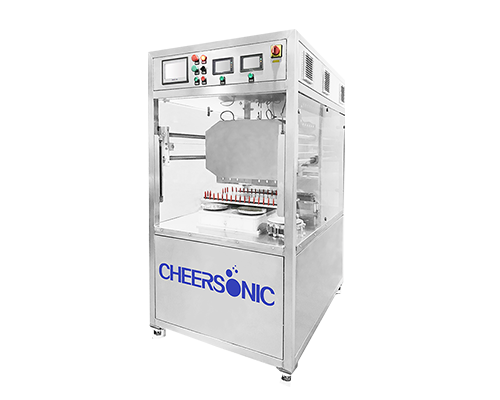
The core pain points of traditional slicing techniques
The conventional mechanical slicing method is prone to exposing many defects when processing such double-layer heterogeneous snacks. For the top soft coating, the squeezing of mechanical tools can cause the coating to adhere to the tool, deform the edges, and cause problems such as “wire drawing” and “edge overflow”; Under the impact of cutting tools, the middle grain substrate may experience edge fragmentation and slag falling, which can damage the integrity of the product. In addition, it is difficult to control the dimensional accuracy of rectangular strips, and traditional processes are difficult to ensure consistency in length, width, and thickness (with errors often exceeding ± 0.5mm), which affects the regularity of product appearance and packaging compatibility. At the same time, the pressure generated by mechanical slicing may also lead to the separation of the two layers at the interface, reducing the stability of product quality.
Adaptation advantages of ultrasonic slicing technology
The ultrasonic slicer drives the slicing tool through high-frequency vibration (usually 20-40kHz) to form micrometer level vibration cutting motion, perfectly adapting to the slicing needs of double-layer heterogeneous snacks. Its core advantages are reflected in three aspects: firstly, vibration cutting reduces the contact area between the tool and the material, significantly reducing the adhesion phenomenon of the top soft coating. After slicing, the coating edge is flat and smooth, without deformation or overflow; The second is the “micro cutting” effect generated by high-frequency vibration, which can complete cutting without damaging the middle grain substrate structure, avoiding edge fragmentation and slag falling, and ensuring product integrity; Thirdly, precise parameter control (vibration frequency, feed rate, slice thickness) can achieve high-precision machining of rectangular strips, with dimensional errors controlled within ± 0.2mm, meeting the standardized requirements of large-scale production.
Key points of process optimization and production application
To fully leverage the advantages of ultrasonic slicing technology, the following parameters need to be controlled during the production process: firstly, slicing temperature control. It is recommended to maintain the material temperature at 15-20 ℃, which not only avoids excessive adhesion of the top soft coating due to high temperature, but also prevents the brittleness of the middle grain substrate from increasing due to low temperature; Next is the adjustment of tool parameters. Based on the characteristics of the two-layer texture, the matching relationship between vibration frequency and feed rate is optimized. Generally, the higher the proportion of soft coating, the higher the vibration frequency (35-40kHz) needs to be appropriately increased to enhance the cutting effect; Finally, equipment maintenance involves regularly cleaning the residual coating materials on the surface of the cutting tools, maintaining the stability of the vibration system, and avoiding a decrease in slicing quality due to tool wear.
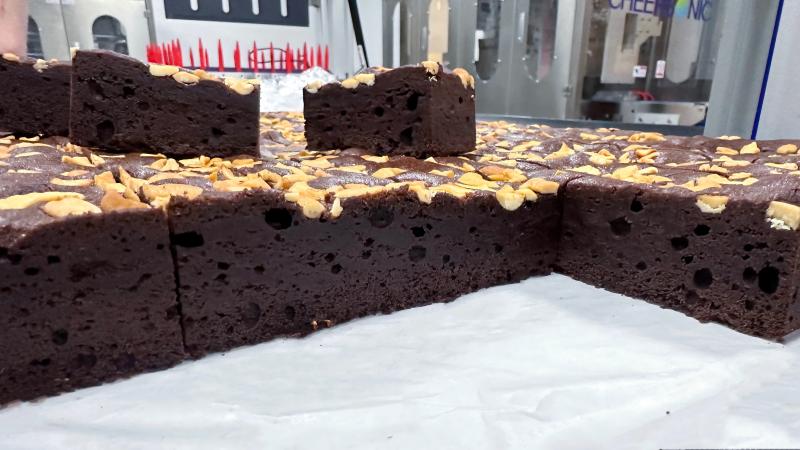
In actual production, the ultrasonic slicer can form an automated production line with front-end composite forming equipment and back-end packaging equipment, with a slicing efficiency of 300-500 pieces per minute, meeting the needs of large-scale production. At the same time, its gentle cutting method will not damage the interface bonding of the two-layer structure, and the sliced product maintains good morphological integrity and consistent taste, significantly enhancing the product’s market competitiveness.
About Cheersonic
Cheersonic manufactures the leading portioning equipment for bakeries producing fresh and frozen desserts. Since 1998 bakers have used Cheersonic machines to cut, slice and portion cheesecake, pie, layer cake, loaves, butter, cheese, pizza, sandwichs, and more. Cheersonic offers ultrasonic cutting solutions that support start-up bakeries and high production commercial facilities alike. Small standalone machines can be used in manual baking facilities and large inline robotic solutions aid in high speed production.
Cheersonic offers many ultrasonic slicing models, both inline and offline applications, with production speeds of 80 to 1,500 cakes or pies per hour.
Cheersonic’ latest offline introductions include ultrasonic cutting with or without divider inserts between each slice. This improves the quality of the cut and makes for a much better product presentation for the customer. In addition, robotic arm improves the speed, efficiency, and accuracy of the cutting process, producing professional looking products every time.
Chinese Website: Cheersonic Provides Professional Ultrasonic Cutting Solutions