
Ultrasonic Slicers for Cutting Bread and Toast
Core Principles, Advantages, and Key Applications of Ultrasonic Slicers for Cutting Bread and Toast
In the industrial processing of bread (especially toast), ultrasonic slicers, with their unique cutting method, address the pain points of traditional knives for cutting soft, porous bread, such as chipping, collapse, and uneven slices. These devices have become key equipment for improving slice quality and production efficiency. The following details its features for cutting bread and toast from four perspectives: operating principle, core advantages, applicable scenarios, and application considerations.
Core Operating Principle: High-Frequency Vibration Achieves “Pressure-Free Cutting”
The cutting logic of an ultrasonic slicer is fundamentally different from that of traditional mechanical knives (which rely on physical compression to cut through ingredients). Its core lies in high-frequency mechanical vibration:
- Vibration Source Drive: The device’s built-in ultrasonic generator converts electrical energy into high-frequency mechanical vibrations of 20-40kHz, which are then transmitted to a dedicated cutting head (or vibrating plate);
- Micro-Cutting Action: High-frequency vibrations cause the cutter head to produce tens of thousands of tiny “reciprocating” movements per second. This vibration rapidly breaks down the gluten network and pore structure within the bread, achieving a “separation-based cutting” approach, rather than the “compression-based cutting” of traditional knives;
- Low Contact Pressure: During the cutting process, the actual contact pressure between the cutter head and the bread is extremely low, with the cutting effect achieved solely through vibration energy, avoiding physical compression of the bread’s soft texture.
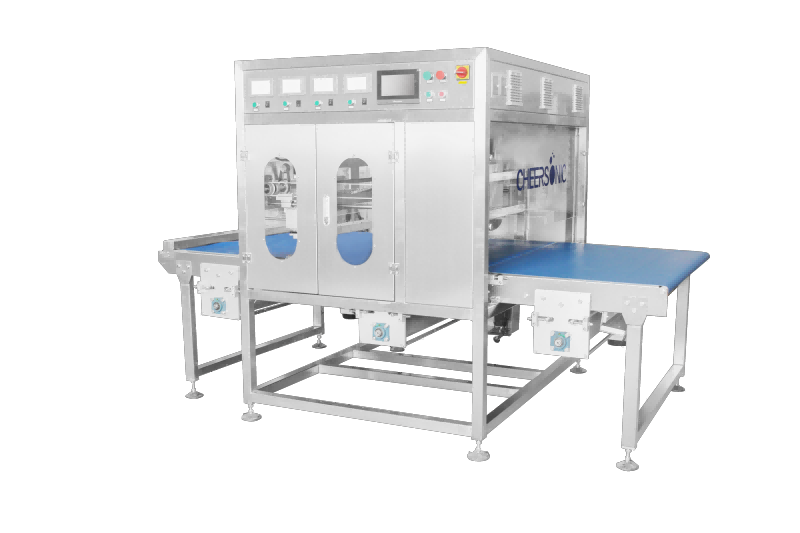
Four Core Advantages for Bread and Toast
Bread (especially toast) has a soft texture, is filled with tiny pores formed by fermentation, and retains a certain elasticity even after cooling. Traditional knife cutting can easily lead to problems such as chipping, collapse, and slice deformation. Ultrasonic slicers specifically address these pain points:
- Reduces scraping waste: No noticeable chipping occurs during cutting, resulting in smooth edges and only a trace amount of powder (far less than the 10%-15% scraping rate of traditional knives). This reduces raw material loss and improves production efficiency.
- Produces consistent slice shape: Pressure-free cutting prevents collapse or concave edges caused by compression, maintaining a complete rectangular shape without deformation. This facilitates subsequent automated packaging (neatly stacking) and enhances product aesthetics.
- Precise and controllable thickness: Utilizing a servo motor and sensor, slice thickness can be precisely adjusted (typically 3-20mm), with a strict tolerance of ±0.5mm. This meets diverse consumer needs (e.g., thick-cut toast for sandwiches, thin-cut toast for breakfast) and ensures consistent texture from slice to slice.
- Protecting Bread Structure: Vibration cutting does not disrupt the pore structure of the bread, maintaining a soft and fluffy texture after slicing, avoiding the “compacting and hardening” caused by traditional cutting. This method preserves the bread’s original texture and flavor, enhancing the consumer experience.
Application Scenarios: Focusing on Soft and Porous Breads
Ultrasonic slicers are not suitable for all types of bread. However, their advantages are particularly evident in soft, high-moisture, and porous breads. Core applicable categories include:
- Toast: White toast, whole wheat toast, and multi-grain toast (the primary application, almost standard in industrial toast production lines);
- Soft bread: Dinner rolls and prepared breads (such as cream bread and red bean bread, to prevent fillings from overflowing due to squeezing);
- Cakes: Sponge cakes and chiffon cakes (for softer textures, ultrasonic cutting reduces the risk of crushing).
*Note: For hard, dense breads (such as European-style bread and baguettes), ultrasonic cutting efficiency is lower due to the hard crust and large, compact pores within. Dedicated hard bread slicers are more suitable. *

Application Considerations: Ensuring Cutting Performance and Equipment Lifespan
1. Matching Bread Conditions: Cut bread completely after it has cooled (core temperature 25-28°C). Warm bread is too soft, and even ultrasonic cutting can cause slight deformation due to structural instability.
2. Parameter Adjustment: Adjust the vibration frequency and cutting speed based on the texture of the bread. (For example, for soft bread, reduce the vibration frequency and speed to avoid structural damage caused by excessive vibration. For firmer whole-wheat bread, increase the frequency to enhance cutting force.)
3. Regular Cleaning and Maintenance: After cutting, promptly remove bread crumbs from the gap between the blade and the equipment. Residual crumbs can affect vibration efficiency, and long-term accumulation can breed bacteria and contaminate subsequent products.
4. Blade Maintenance: Although ultrasonic blades wear slowly, the flatness of the vibrating plate should be checked after extended use. If deformation or cracks are detected, replace them promptly to avoid compromising cutting accuracy.
About Cheersonic
Cheersonic manufactures the leading portioning equipment for bakeries producing fresh and frozen desserts. Since 1998 bakers have used Cheersonic machines to cut, slice and portion cheesecake, pie, layer cake, loaves, butter, cheese, pizza, sandwichs, and more. Cheersonic offers ultrasonic cutting solutions that support start-up bakeries and high production commercial facilities alike. Small standalone machines can be used in manual baking facilities and large inline robotic solutions aid in high speed production.
Cheersonic offers many ultrasonic slicing models, both inline and offline applications, with production speeds of 80 to 1,500 cakes or pies per hour.
Cheersonic’ latest offline introductions include ultrasonic cutting with or without divider inserts between each slice. This improves the quality of the cut and makes for a much better product presentation for the customer. In addition, robotic arm improves the speed, efficiency, and accuracy of the cutting process, producing professional looking products every time.
Chinese Website: Cheersonic Provides Professional Ultrasonic Cutting Solutions
