
Yogurt Stick Cutting
Application of Ultrasonic Cutting Machines in Yogurt Stick Cutting Processing
In the yogurt stick processing industry, the precision and efficiency of the cutting process directly determine product quality and market competitiveness. Traditional mechanical cutting often faces problems such as blade sticking, rough cuts, and product deformation. Ultrasonic cutting technology, with its unique working principle, provides a highly efficient and precise solution for yogurt stick processing, becoming an important support for industry upgrading.
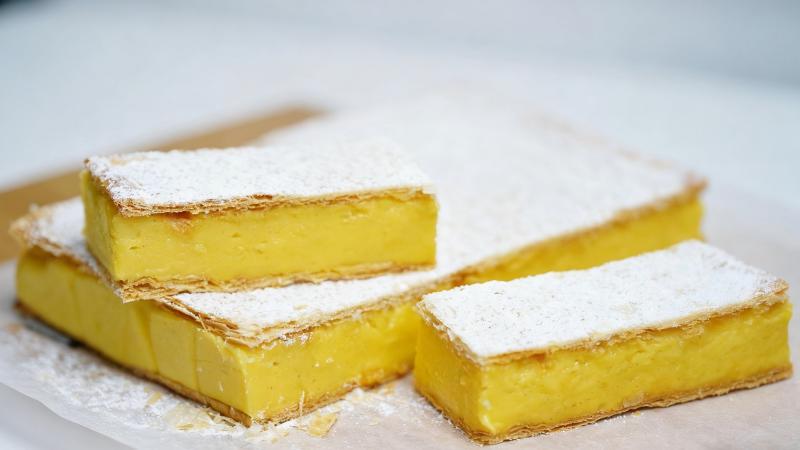
The core principle of ultrasonic cutting of yogurt sticks is to achieve precise material separation using high-frequency mechanical vibration. The system mainly consists of three parts: an ultrasonic generator, a transducer, and a cutting head. The generator converts electrical energy into a 20-40kHz high-frequency electrical signal, which is then converted into mechanical vibration of the same frequency by the transducer. This vibration is amplified by the cutting head and transmitted to the blade. During cutting, the blade vibrates at a high frequency of 20,000 to 40,000 times per second, generating localized high pressure at the contact point with the yogurt stick. This causes the material molecular chains to break rapidly, achieving separation. Simultaneously, the micro-thermal effect generated by the vibration softens surface grease and adhesives, effectively reducing adhesion. This “pressure-free” cutting mode requires only minimal downward pressure to complete the cut, fundamentally preventing yogurt sticks from being crushed or deformed.
Compared to traditional cutting methods, ultrasonic cutting demonstrates significant advantages in yogurt stick processing. Firstly, it offers superior cutting quality, producing smooth, even cuts without any debris residue, perfectly preserving the original shape and texture of the yogurt sticks and improving product appearance consistency. Because yogurt sticks contain milk fat and sugar, they are highly adhesive, and traditional blades are prone to sticking, resulting in rough cuts. The high-frequency vibration of ultrasound creates “micro-separation” between the blade and the material, significantly reducing frictional resistance and achieving clean cutting. Secondly, it greatly improves production efficiency. The equipment can be easily integrated into automated production lines, enabling high-speed continuous cutting. The cutting speed can be flexibly adjusted according to the production line’s rhythm, adapting to large-scale production needs while reducing downtime for cleaning the blades. Thirdly, it reduces product waste. Precise cutting control minimizes raw material loss due to breakage and deformation, especially for high-value yogurt stick products, significantly improving raw material utilization. Fourth, it offers higher hygiene and safety. The high-frequency vibration of the blade has a self-cleaning effect, reducing the growth of bacteria from material residue. Furthermore, the equipment design typically meets food hygiene standards, is easy to disassemble and clean, and reduces the risk of cross-contamination.
In practical applications, ultrasonic cutting of yogurt strips requires careful control of key parameters to ensure optimal results. For frequency selection, 20-30kHz is the most commonly used range, balancing cutting force and precision, and adaptable to yogurt strips of varying hardness. The amplitude needs to be adjusted according to the texture of the yogurt strips; a medium amplitude is sufficient for soft yogurt strips to avoid structural damage, while a larger amplitude is required for hard or frozen yogurt strips. The cutting speed should be precisely synchronized with the production line conveyor speed, typically controlled between 10-30mm/s, ensuring uniform length of each yogurt strip with an error controlled within millimeters. The blade material is preferably food-grade special steel or titanium alloy, possessing good fatigue resistance and thermal conductivity, maintaining blade sharpness under high-frequency vibration, and extending service life. Furthermore, the pre-treatment state of the yogurt sticks also affects the cutting effect. Typically, the product needs to be frozen to a core temperature ≤-18℃ to ensure structural stability and prevent sticking or breakage during cutting.
Ultrasonic cutting technology also provides greater flexibility in yogurt stick processing. By changing different shaped blades, various shapes such as straight strips and wavy patterns can be easily cut to meet diverse market demands. At the same time, the equipment is compact and can work with robotic arms to achieve multi-angle cutting, adapting to different production scenarios and flexibly applicable from small workshops to large factories. In terms of green production, this technology operates with low noise, requires no additional release agents, and does not pollute the environment, meeting the environmental protection requirements of modern food industry.
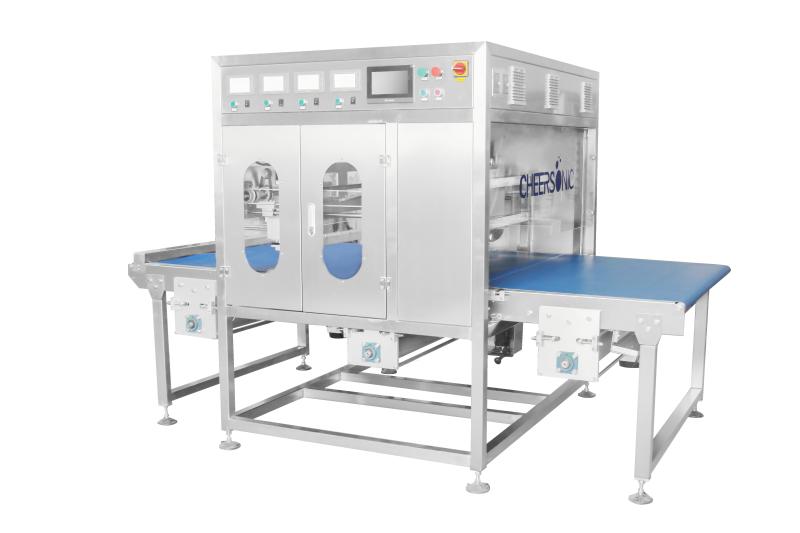
With the intelligent upgrading of the food processing industry, the application prospects of ultrasonic cutting technology in yogurt stick processing are becoming increasingly broad. It not only solves many pain points of traditional cutting but also creates greater economic benefits for enterprises by improving product quality, reducing costs, and increasing efficiency. In the future, with continuous technological optimization, ultrasonic cutting equipment will achieve further breakthroughs in precise parameter control and intelligent adaptation, bringing more efficient solutions for the processing of yogurt bars and various sticky and soft foods.
About Cheersonic
Cheersonic manufactures the leading portioning equipment for bakeries producing fresh and frozen desserts. Since 1998 bakers have used Cheersonic machines to cut, slice and portion cheesecake, pie, layer cake, loaves, butter, cheese, pizza, sandwichs, and more. Cheersonic offers ultrasonic cutting solutions that support start-up bakeries and high production commercial facilities alike. Small standalone machines can be used in manual baking facilities and large inline robotic solutions aid in high speed production.
Cheersonic offers many ultrasonic slicing models, both inline and offline applications, with production speeds of 80 to 1,500 cakes or pies per hour.
Cheersonic’ latest offline introductions include ultrasonic cutting with or without divider inserts between each slice. This improves the quality of the cut and makes for a much better product presentation for the customer. In addition, robotic arm improves the speed, efficiency, and accuracy of the cutting process, producing professional looking products every time.